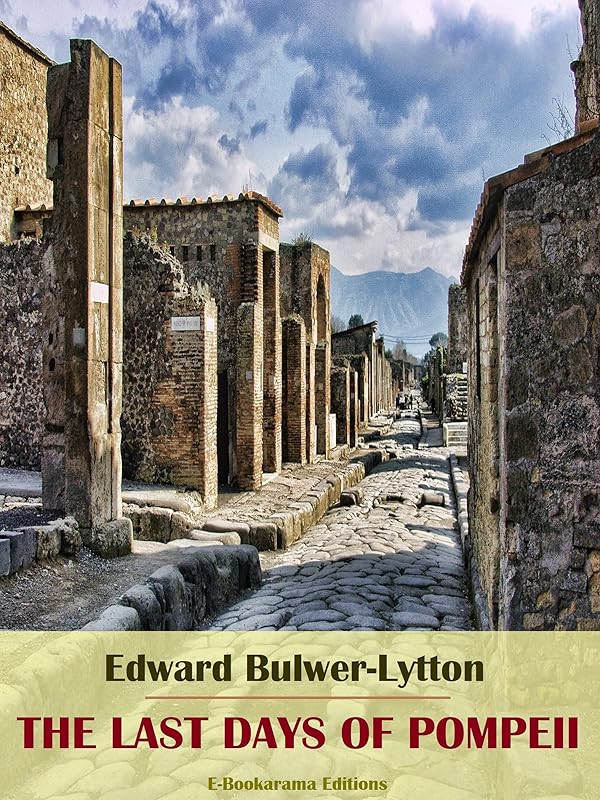
Edward Bulwer-Lytton (1803-1873) was a prolific novelist, poet and playwright in his day; in modern times, his work is considered much as Lovecraft described: "large doses of turgid rhetoric and empty romanticism.". . Originally published in 1834, "The Last Days of Pompeii" itself was probably the first novelization of the catastrophic event. The city was rediscovered in the mid-1700s and archaeological excavations followed soon after. Bulwer-Lytton was inspired to write his novel by the painting The Last Day of Pompeii by Karl Briullov, painted in the early 1830s.. . "The Last Days of Pompeii" tells the story of the Athenian Glaucus, his love, the beautiful Ione, and a blind flower-girl Nydia, who is secretly in love with Glaucus. Threatening the love of Glaucus and Ione is Ione's guardian, the decadent and deceitful Egyptian Arbaces, who lusts after Ione himself.. . The descriptions of the city itself are fascinating: Bulwer-Lytton seems to have spent much time researching the actual ruins of Pompeii, and his characters are housed in buildings that had apparently been uncovered in archaeological excavations.. . "The Last Days of Pompeii" was one of the most popular English historical novels of the nineteenth century.