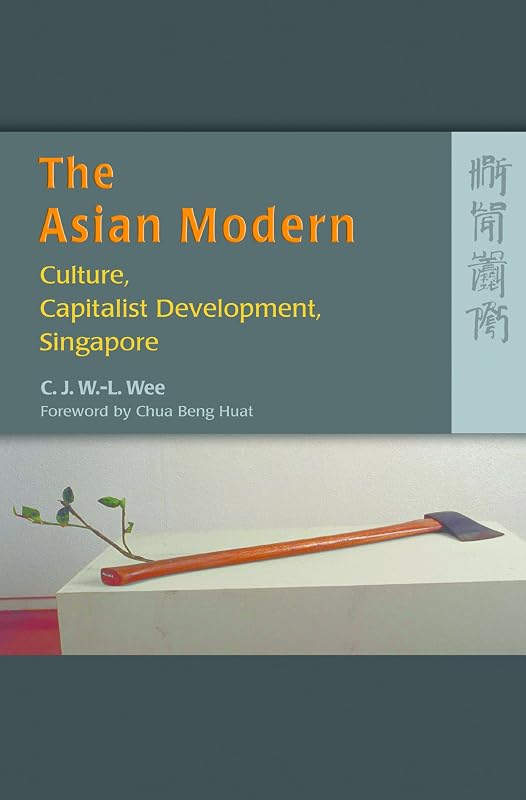
The Asian Modern: Culture, Capitalist Development, Singapore
C. J. W.-L. Wee
224 pages
Hong Kong University Press
Jul 2010
Hardcover
History
WSBN
How does one comprehend the phenomenon of the modernization of an Asian society in a globalized East Asian context? With this opening question, the author proceeds to give an account of how the modernization processes for postcolonial societies in Asia, such as those of India, Malaysia, and Singapore, are fraught with collaborations and conflicts between different socio-political, historical, economic, and cultural agents. Such ambivalent dynamics contribute to what Wee argues as a 'revealing distortion' of the extant models of Western modernity, which is nonetheless rooted in the politics of worldwide capitalism.
Wee's narrative refuses to accept the uncritical interpretation of the modernizing processes in Asia as liberation from the hegemony of Euro-American capitalism. But neither is Wee prepared to concede that all cultural initiatives in the postcolonial societies are, therefore, denied all power to devise alternative forms of expression in the face of this haunting presence. It is the persistent effort to see the many faces of modernization in Asia in their full complexity that sets this study apart.
Readers will discover that what seems to be the modernization of a single geopolitical entity is inevitably linked to the dynamics of various agents in other locations at different times, which makes us reflect on the existence of the many 'distortions' in our societies.
C. J. W.-L. Wee is an associate professor of English at Nanyang Technological University, Singapore, and was formerly a fellow in the Institute of Southeast Asian Studies, Singapore. He has been a visiting fellow at the Centre for the Study of Developing Societies, Delhi, India and at the Humanities Research Centre, Australian National University. He is the author of Culture, Empire, and the Question of Being Modern (2003) and the editor of Local Cultures and the "New Asia": The State, Culture, and Capitalism in Southeast Asia (2002) ; he also is the co-editor of Two Plays by Kuo Pao Kun (2002) , and is presently co-editing Contesting Performance: Global Genealogies of Research with two other scholars . His recent research interest concerns questions of modernism, postmodernism and the contemporary arts and culture in the East/Southeast Asian context.
"Situating cultural studies in the midst of a complex array of 'Asianizing', 'reethnicizing', and 'relocalizing' forces, Wee has become a kind of Garcia-Canclini of the Pacific Rim, tracing a paradoxical situation in which 'exuberant modernization' in Singapore has gone hand in glove with a 'deficient modernism'. The Asian Modern reveals a vibrancy of culture emergent in Singapore, as theater, literature, film, painting, and architecture come alive with all these tensions, masks, fabrications, and codes. No study tracks this portrait of global/local Singapore with greater scope, discursive richness, density of detail and cosmopolitical speculation than takes place in The Asian Modern."
- Rob Wilson, Professor of Literature, University of California, Santa Cruz, author of Reimagining the American Pacific and Waking in Seoul