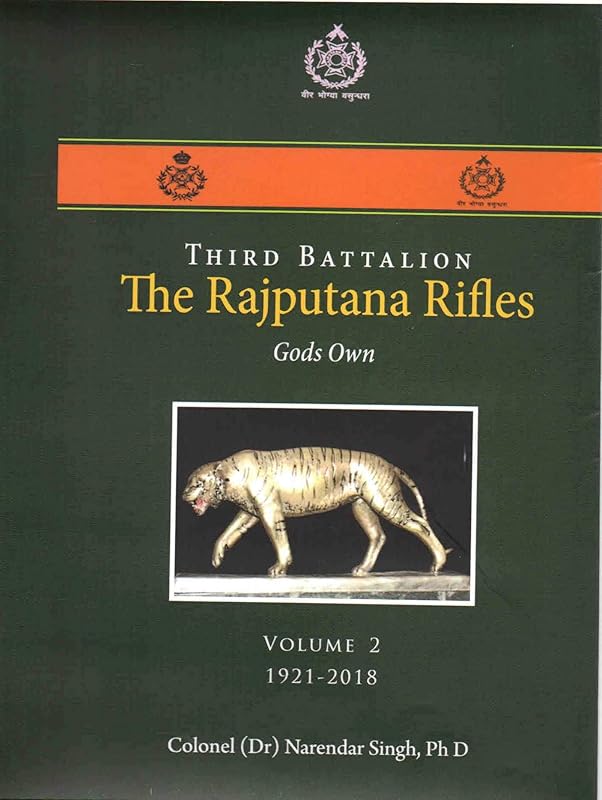
Third Battalion The Rajputana Rifles Gods Own: Vol 2: 1921-2018 by Col (Dr)  Narendar Singh

Third Battalion The Rajputana Rifles Gods Own: Vol 2: 1921-2018

Col (Dr) Narendar Singh
Pentagon Press
Jan 2020
Paperback
History WSBN
0
Readers
0
Reviews
0
Discussions
0
Quotes
The history of the 3rd Battalion The Rajputana Rifles, `Gods Own` for the period 1921 to 2018 is covered as Volume 2. British Empire was at its zenith at the commencement of World War 1. The First World War ended on 11 November 1918 with the Government of India poised on the brink of becoming a regional power. To some in London, it seemed as if New Delhi would shortly even become the eastern capital of the Empire. In 1921 reorganization of Indian Army took place and Infantry Regiments were grouped. Battalions were now formed into Regimental Groups. The 3rd Battalion The Rajputana Rifles was converted to Rifle Regiment in 1921.Indianization of the Army was on the agenda. There was strong resistance from within the British Officer Corps to accept Indian Commissioned Officers. Recruiting problems were especially complex in colonial India, where the fissures and fluidities of caste added to the great diversity of language and religion amongst local population. The English created the myth of martial classes. The interwar period saw the Battalion serving in the North West carrying out the `scorched earth policy` by taking punitive expeditions to quell the tribal and keep them under some order, both in North West Frontier Province and Burma. Battalion assisted in raising the first Battalion of Crown Representative Police. Battalion during the Burma Campaign was cited and had the honour of winning the Battle Honour `Kyaukmyaung Bridgehead, Irrawaddy River`. Battalion for its act was given the honour to lead the march into Mandalay. Post-Independence Battalion had the unique honour of winning the National Defence Academy Sports trophy three times in succession. It was also the first battalion to win the Regimental Reunion Banner three times in succession. Battalion had its share of participating in counter insurgency operations. In 1965 Battalion operated in Poonch Sector where it attained success as Meghdoot Force and had the privilege of linking up with Indian Army troops advancing from Uri. The battalion had the biggest success in the whole of the Western Theatre when it captured Islamgarh. Capture of Islamgarh is a classic example of surprise and attacking from line of march. There are no good battalions or bad Battalions, the performance of the Battalion depends upon the leadership or the Officers. In this the Commanding Officer has the primary role. The Indian society has been going through changes and these changes will affect the battalion as men come from society. There is a need to assuage the tension which is prevalent in society so that men perform to best of his ability. Effort has been made to bring out the facts, and not get carried away in hindsight and any attachment. If there are no records or evidence, then it becomes fantasy.
Join the conversation

No discussions yet. Join BookLovers to start a discussion about this book!

No reviews yet. Join BookLovers to write the first review!

No quotes shared yet. Join BookLovers to share your favorite quotes!

Earn Points
Your voice matters. Every comment, review, and quote earns you reward points redeemable for Bitcoin.
Comment +5 pts Review +20 pts Quote +7 pts Upvote +1 pt
BookMatch Quiz
Find books similar to this one
About this book
Publisher Pentagon Press
Published 2020
Readers 0