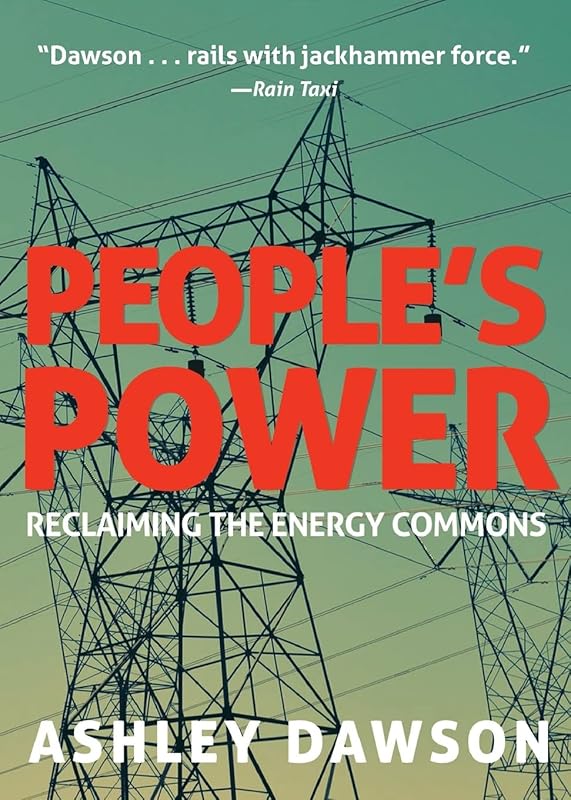
People's Power: Reclaiming the Energy Commons
Ashley Dawson
The science is conclusive: to avoid irreversible climate collapse, the burning of all fossil fuels will have to end in the next decade. In this concise and highly readable intervention, Ashley Dawson sets out what is required to make this momentous shift: simply replacing coal-fired power plants with for-profit solar energy farms will only maintain the toxic illusion that it is possible to sustain relentlessly expanding energy consumption. We can no longer think of energy as a commodity. Instead we must see it as part of the global commons, a vital element in the great stock of air, water, plants, and cultural forms like language and art that are the inheritance of humanity as a whole.
People's Powerprovides a persuasive critique of a market-led transition to renewable energy. It surveys the early development of the electric grid in the United States, telling the story of battles for public control over power during the Great Depression. This history frames accounts of contemporary campaigns, in both the United States and Europe, that eschew market fundamentalism and sclerotic state power in favor of energy that is green, democratically managed and equitably shared.
Read more Continue reading Read less REVIEW
"An elegant, controversial thesis" -- The Guardian
"For anyone wanting to understand what comes after oil and how we might get there."
-- Imre Szeman, author ofOn Petrocultures
"A gift to activists, providing a clear and accessible history of energy as well as a vision towards the publicly owned, democratically controlled, 100% renewable world we need."
-- Aaron Eisenberg, the Rosa Luxemburg Foundation
"A brilliant guide to building collective, equitable, and radical energy democracies in the here and now."
-- Lavinia Steinfort, Transnational Institute
ABOUT THE AUTHOR
Ashley Dawsonis a professor of English at CUNY, New York City. He is the author ofMongrel NationandThe Routledge Concise History of Twentieth-Century British Literature, as well as a short story in the anthologyStaten Island Noir.
EXCERPT. REPRINTED BY PERMISSION. ALL RIGHTS RESERVED.
THE ENERGY COMMONS
From the Introduction
We need a rapid and just transition beyond fossil fuels. We are only going to get such a transition if we can wrench control of our energy systems out of the hands of profit-seeking corporations with a strong stake in continuing business as usual. The struggle for democratic control over energy production, distribution, and use is consequently the key front in the fight for a better, sustainable world. It is not simply that it's taking too long to make the transition. The problem is a more fundamental one. The capitalist system which orients current efforts to shift energy regimes is based on a fundamental logic: grow or die. This growth imperative is a recipe for the mass extinction of most species on a finite planet.[i] As long as energy production remains grounded in the logic of the capitalist market, it will continue to obey capitalism's fundamentally irrational drive to generate ceaselessly expanding profits through endless growth. If capitalists can make money off fossil fuels, they will continue to drill holes in the earth, damn the environmental and social consequences. Since fossil fuel corporations have immense amounts of assets sunk into existing infrastructures, they will fight to prevent a transition to a zero-carbon society - despite the occasional charade of moving "beyond petroleum." Truly sustainable energy production will only be possible if power is taken out of the hands of these gargantuan profit-seeking corporations and their flunkeys in the halls of state. Power, in both senses of the term, must consequently be controlled by ordinary citizens and communities. Decisions about energy generation and the transition to renewable energy need to be oriented around genuine collective needs and framed by a horizon more ample and more sane than the nihilistic, short-term perspectives of the capitalist system. If our collective future is presently being determined by a small cabal of fossil oligarchs, who are making money while driving the planet towards biological annihilation, the alternative to such folly is to collectivize the control of energy and to organize a just transition to renewable power through participatory, democratic control.
In order to make this power shift, we need to stop thinking of energy as a commodity and instead conceive of it as part of the global commons, a vital element in the great stock of air, water, plants, and collectively created cultural forms like music and language that have traditionally been regarded as the inheritance of humanity as a whole.[ii] The commons are made up of material things, those tangible, finite resources such as clean air and water upon which all life depends. But the commons also consist of intangible, non-finite collective resources such as knowledge, shared customs, means of communication, and even more ineffable things such as collective affects, all of which might be termed the social commons. Energy needs to be thought of as both sorts of commons since it is composed of both the "natural resources" (coal, oil, gas, wind, sun, tides, etc.) from which power is generated and of the technologically and socially distributed power derived from these resources. That energy ought to be thought of as a common good - literally, as common wealth - is clear when one scrutinizes its sources, the product of their social use, and the urgent need for a just transition to renewable energy.[iii]
In terms of the sources of energy, it should be quite clear that both fossil fuels like coal and oil and sources of renewable energy like the wind and the sun are part of the natural commons. They are physical resources (in the case of fossil fuels, finite ones) that should be shared equally throughout society. The fact that they presently are not equally distributed,