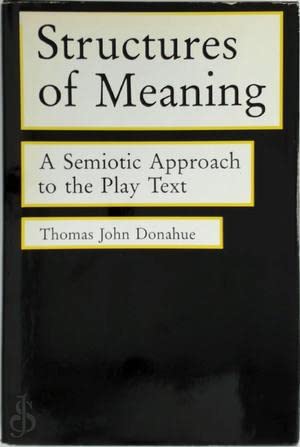
Structures of Meaning: A Semiotic Approach to the Play Text by Thomas John Donahue

Structures of Meaning: A Semiotic Approach to the Play Text

Thomas John Donahue
181 pages
UNKNO
Jan 1993
Hardcover
All Non-Fiction WSBN
0
Readers
0
Reviews
0
Discussions
0
Quotes
Structures of Meaning deals in a practical way with theater semiotics. Although not a "primer" in the strictest sense, it sets forth the basic principles of semiotics as they can be applied to the dramatic or play text and especially its relationship to performance. Author Thomas J. Donahue treats the essential elements of most play texts: action, character, space and time, as well as the characters' discourse and the playwright's instructions in their varied forms. He uses plays from various periods and cultures to illustrate the pragmatic aspects of semiotics, while relying principally on the texts of Romeo and Juliet, Tartuffe, The Cherry Orchard, and Waiting for Godot.In this century directors and other practitioners of the theater have insisted that the play text reaches full significance only within the performance. Their insistence that the play text is "something to be done," as Roland Barthes has put it, and not merely something to be read, necessarily influences the way the reader approaches the text intended for representation on the stage. Theater practitioners have always intuited the transformations that take place while they move from first reading through rehearsal to opening night. They know that the written word is transformed when spoken by an actor, and that stage action, lights, sounds, and an audience bring life to a text that might have seemed dull on first reading. Practitioners of the theater read play texts as if they were preparing a production of a play. They are theater semioticians of a practical order.Semiotics of the play text attempts to identify and define the basic grammar of the text - its syntax - while exploring the various ways it produces meaning within a particular context. This it does through an examination of the various systems of signs within the text and their interrelationships. Although originally used by Ferdinand de Saussure as a means of examining how language functions, semiotics no longer is restricted to natural languages but encompasses the study of all sign systems - both simple and complex. The languages of the theater are, of course, of the complex variety and function in combination to form an elaborate act of communication.While putting in relief wherever possible the relationship of the play text and the performance, Donahue synthesizes the works of the leading proponents of theater semiotics: Keir Elam, Anne Ubersfeld, the members of the Prague Linguistic Circle, as well as speech act theorists whose works have importance for the study of the theater. Since the jargon of semiotics has to a certain extent limited its access to a larger audience, the author has avoided its use when possible and has explained in a clear and precise way those terms from the lexicon of semiotics essential to his study.
Join the conversation

No discussions yet. Join BookLovers to start a discussion about this book!

No reviews yet. Join BookLovers to write the first review!

No quotes shared yet. Join BookLovers to share your favorite quotes!

Earn Points
Your voice matters. Every comment, review, and quote earns you reward points redeemable for Bitcoin.
Comment +5 pts Review +20 pts Quote +7 pts Upvote +1 pt
BookMatch Quiz
Find books similar to this one
About this book
Pages 181
Publisher UNKNO
Published 1993
Readers 0