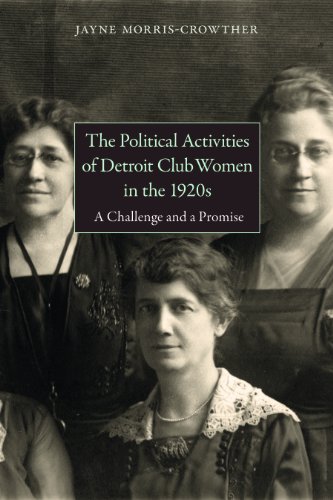
The Political Activities of Detroit Clubwomen in the 1920s: A Challenge and a Promise by Jayne Morris-Crowther

The Political Activities of Detroit Clubwomen in the 1920s: A Challenge and a Promise

Jayne Morris-Crowther
217 pages
Wayne State University Press
Mar 2013
History WSBN
0
Readers
0
Reviews
0
Discussions
0
Quotes
<p>In the early 1900s, Detroit's clubwomen successfully lobbied for issues like creating playgrounds for children, building public baths, raising the age for child workers, and reforming the school board and city charter. But when they won the vote in 1918, Detroit's clubwomen, both black and white, were eager to incite even greater change. In the 1920s, they fought to influence public policy at the municipal and state level, while contending with partisan politics, city politics, and the media, which often portrayed them as silly and incompetent. In this fascinating volume, author Jayne Morris-Crowther examines the unique civic engagement of these women who considered their commitment to the city of Detroit both a challenge and a promise.</p><p> </p><p> By the 1920s, there were eight African American clubs in the city (Willing Workers, Detroit Study Club, Lydian Association, In As Much Circle of Kings Daughters, Labor of Love Circle of Kings Daughters, West Side Art and Literary Club, Altar Society of the Second Baptist Church, and the Earnest Workers of the Second Baptist Church) ; in 1921, they joined together under the Detroit Association of Colored Women's Clubs. Nearly 15,000 mostly white clubwomen were represented by the Detroit Federation of Women's Clubs, which was formed in 1895 by the unification of the Detroit Review Club, Twentieth Century Club, Detroit Woman's Club, Woman's Historical Club, Clio Club, Wednesday History Club, Hypathia, and Zatema Club. Morris-Crowther<i> </i>begins by investigating the roots of the clubs in pre-suffrage Detroit and charts their growing power. She goes on to consider the women's work in three areas-Policies That Affect Women and Children, Protecting the Home against Enemies, and Home as Part of the Urban Environment-and considers the numerous challenges they faced in The Limits of Enfranchised Citizens. An appendix contains the 1926 Directory of the Detroit Federation of Women's Clubs<i>.</i></p><p> </p><p> In the end, Morris-Crowther shows that Detroit's clubwomen pioneered new lobbying techniques like personal interviews, and used political education in savvy ways to bring politics to the community level. This volume will be interesting reading for enthusiasts of Detroit history and readers wanting to learn more about women and politics of the 1920s.</p>
Join the conversation

No discussions yet. Join BookLovers to start a discussion about this book!

No reviews yet. Join BookLovers to write the first review!

No quotes shared yet. Join BookLovers to share your favorite quotes!

Earn Points
Your voice matters. Every comment, review, and quote earns you reward points redeemable for Bitcoin.
Comment +5 pts Review +20 pts Quote +7 pts Upvote +1 pt
BookMatch Quiz
Find books similar to this one
About this book
Pages 217
Publisher Wayne State Universi...
Published 2013
Readers 0