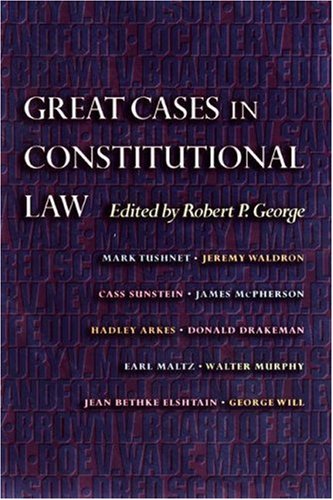
From Publishers Weekly This collection of scholarly but accessible essays (George is a professor of jurisprudence at Princeton) addresses the role of the U.S. Supreme Court in interpreting the Constitution. In its 1803 decision in Marbury v. Madison, the Supreme Court asserted the judiciary's province, and in fact duty, to "say what the law is," and since then the justices have regularly decided whether federal or state laws pass muster under the Constitution. Five landmark constitutional cases form the core of this book: Marbury, the Dred Scott case on slavery (one essay is by James M. McPherson), Lochner v. New York on social legislation, Brown v. Topeka Board of Education on equality in public schools and Roe v. Wade on abortion rights (essays are by Jean Bethke Elshtain and George Will). Each case is the subject of a principal essay, followed by a response purportedly written from a different perspective. The prevailing attitude is disapproval of "judicial activism," in which justices, purporting to find their personal moral views enshrined in the Constitution, invalidate acts undertaken by the people's elected representatives. The authors here either advocate "original intent" (limiting constitutional analysis to the text itself and the views of the Founders) or counsel in favor of narrow, fact-based decisions instead of broad policy pronouncements. The principal essays range in style from professorial disputation to impassioned moral advocacy. With one exception (Walter F. Murphy's response to Earl Maltz on the notion of "originalism" as it relates to the Brown decision), the writers of the responsive pieces seem to agree with, and expand upon, the ideas of the main essayists. More contrariety in point of view would have advanced the reader's understanding of how constitutional cases should be decided. Even so, this volume thoughtfully explains the views of those who advocate more of the original Constitution, and less of the Supreme Court, in American political life. (Apr.) Copyright 2000 Reed Business Information, Inc. --This text refers to the