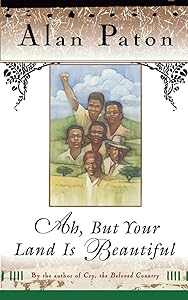
Cry, the Beloved Country
Alan Paton
In the city of Johannesburg a father seeks his delinquent son. His search takes him through a labyrinth of murder, prostitution, racial hatred and, ultimately, reconciliation. Read more FROM PUBLISHERS WEEKLY
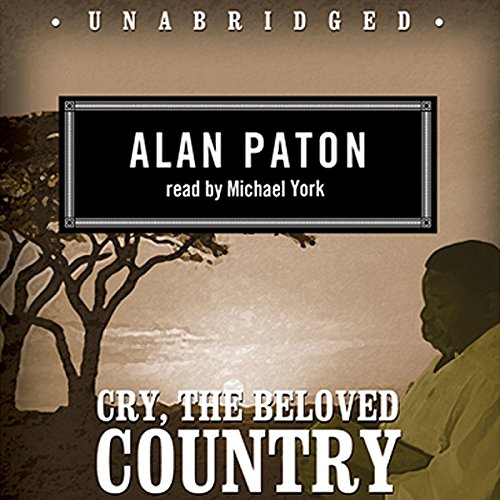
In search of missing family members, Zulu priest Stephen Kumalo leaves his South African village to traverse the deep and perplexing city of Johannesburg in the 1940s. With his sister turned prostitute, his brother turned labor protestor and his son, Absalom, arrested for the murder of a white man, Kumalo must grapple with how to bring his family back from the brink of destruction as the racial tension throughout Johannesburg hampers his attempts to protect his family. With a deep yet gentle voice rounded out by his English accent, Michael York captures the tone and energy of this novel. His rhythmic narration proves hypnotizing. From the fierce love of Kumalo to the persuasive rhetoric of Kumalo's brother and the solemn regret of Absalom, York injects soul into characters tempered by their socioeconomic status as black South Africans. (May)
Copyright Reed Business Information, a division of Reed Elsevier Inc. All rights reserved. REVIEW
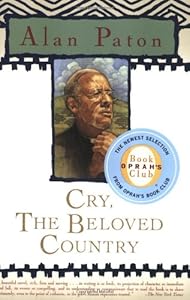
"A beautiful novel, rich, firm and moving...its writing is so fresh, its projection of character so immediate and full, its events so compelling, and its understanding so compassionate that to read the book is to share intimately, even to the point of catharsis, in the grave human experience." (The New York Times)
"The greatest novel to emerge out of the tragedy of South Africa, and one of the best novels of our time." (The New Republic)
"We have had many novels from statesmen and reformers, almost all bad; many novels from poets, almost all thin. In Alan Paton's Cry, the Beloved Country the statesman, the poet, and the novelist meet in a unique harmony." (Literary Critic Lewis Gannett )
ABOUT THE AUTHOR
Alan Paton, a native son of South Africa, was born in Pietermaritzburg, in the province of Natal, in 1903. Paton's initial career was spent teaching in schools for the sons of rich, white South Africans, But at thirty, he suffered a severe attack of enteric fever, and in the time he had to reflect upon his life, he decided that he did not want to spend his life teaching the sons of the rich. He got a job as principal of Diepkloof Reformatory, a huge prison school for delinquent black boys, on the edge of Johannesburg. He worked at Diepkloof for ten years, and at the end of it Paton felt so strongly that he needed a change, that he sold his life insurance policies to finance a prison-study trip that took him to Scandinavia, England, and the United States. It was during this time that he unexpectedly wrote his first published novel, Cry, the Beloved Country. It stands as the single most important novel in South African literature. Alan Paton died in 1988 in South Africa. EXCERPT. REPRINTED BY PERMISSION. ALL RIGHTS RESERVED.
Chapter 1 There is a lovely road that runs from Ixopo into the hills. These hills are grass-covered and rolling, and they are lovely beyond any singing of it. The road climbs seven miles into them, to Carisbrooke; and from there, if there is no mist, you look down on one of the fairest valleys of Africa. About you there is grass and bracken and you may hear the forlorn crying of the titihoya, one of the birds of the veld. Below you is the valley of the Umzimkulu, on its journey from the Drakensberg to the sea; and beyond and behind the river, great hill after great hill; and beyond and behind them, the mountains of Ingeli and East Griqualand.
The grass is rich and matted, you cannot see the soil. It holds the rain and the mist, and they seep into the ground, feeding the streams in every kloof. It is well-tended, and not too many cattle feed upon it; not too many fires burn it, laying bare the soil. Stand unshod upon it, for the ground is holy, being even as it came from the Creator. Keep it, guard it, care for it, for it keeps men, guards men, cares for men. Destroy it and man is destroyed.
Where you stand the grass is rich and matted, you cannot see the soil. But the rich green hills break down. They fall to the valley below, and falling, change their nature. For they grow red and bare; they cannot hold the rain and mist, and the streams are dry in the kloofs. Too many cattle feed upon the grass, and too many fires have burned it. Stand shod upon it, for it is coarse and sharp, and the stones cut under the feet. It is not kept, or guarded, or cared for, it no longer keeps men, guards men, cares for men. The titihoya does not cry here any more.
The great red hills stand desolate, and the earth has torn away like flesh. The lightning flashes over them, the clouds pour down upon them, the dead streams come to life, full of the red blood of the earth. Down in the valleys women scratch the soil that is left, and the maize hardly reaches the height of a man. They are valleys of old men and old women, of mothers and children. The men are away, the young men and the girls are away. The soil cannot keep them any more.
Copyright (c) 1948 by Alan Paton
Read more