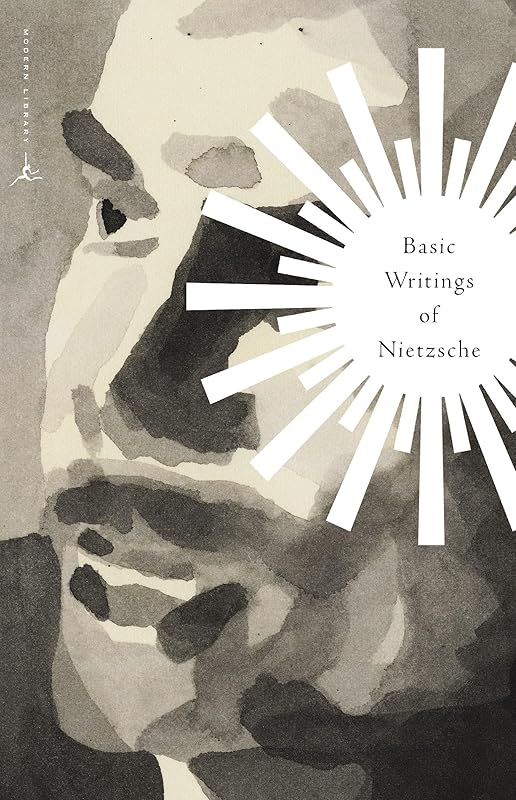

Basic Writings of Nietzsche (Modern Library Classics) by Friedrich Nietzsche

Basic Writings of Nietzsche (Modern Library Classics)

Friedrich Nietzsche
896 pages
Modern Library
Nov 2000
Paperback
Psychology & Philosophy WSBN
3
Readers
1
Reviews
0
Discussions
0
Quotes
This captivating collection brings together five of Friedrich Nietzche's most important philosophical works, exploring themes such as nihilism, metaphysics, and the nature of morality - featuring an introduction by Peter Gay and commentary from Martin Heidegger, Albert Camus, and Gilles DeleuzeMore than one hundred years after his death, Friedrich Nietzsche remains the most influential philosopher of the modern era. Basic Writings of Nietzsche gathers the complete texts of five of Nietzsche's most important works, from his first book to his last: The Birth of Tragedy, Beyond Good and Evil, On the Genealogy of Morals, The Case of Wagner, and Ecce Homo. Edited and translated by the great Nietzsche scholar Walter Kaufmann, this volume also features seventy-five aphorisms, selections from Nietzsche's correspondence, and variants from drafts for Ecce Homo. It is a definitive guide to the full range of Nietzsche's thought.This edition includes a Modern Library Reading Group Guide
Join the conversation

No discussions yet. Join BookLovers to start a discussion about this book!

A fascinating human being of exceptional complexity and integrity (P. Gay)

Nietzsche was the greatest polemist ever. He played the role of Saint-Michael, the dragon slayer, in his Homeric battle with the existing dragons (the Christian moralists). He tried to revalue all generally accepted `good and evil' values and really felt that mankind was pregnant with a new super-species, the `Übermensch'. His influence on philosophy, literature, psychology and politics is immense. Of course, some aspects of his vision on mankind are unacceptable. The all important influence on his Nietzsche's life and philosophy came from Schopenhauer: `I very earnestly denied my `will to life' at the time when I first read Schopenhauer.' The life of a Nietzschean immoralist Life is to express one's will to and lust for power. The cardinal instinct of man is not self-preservation, but the discharge of strength. Everything evil, terrible, tyrannical in man, everything that is kin to beasts of prey and serpents serves the enhancement of the species `man'. This enhancement has always been the work of an aristocratic society. The noble man creates his own morality, his good and bad, with egoism and exploitation as his real nature. He despises the slaves, the unfree, the doglike people who allow themselves to be maltreated. Christian morals, democracy When the aristocratic value judgments declined, the plebeians imposed their own morality of unegoism, pity, self-sacrifice, self-abnegation and ascetic ideals on mankind. The egoistic `good' of the masters became the `evil' of the Christian faith. This faith constitutes not less than a sacrifice of all freedom, enslavement and self-mutilation. By preserving all that is sick, it breads `a mediocre herd animal'. Democracy, `the nonsense of the greatest numbers', with its `equality of rights', is the heir of Christianity. It is a gruesome fact that an anti-life morality received the highest honors and was fixed as a law and a categorical imperative. Art Art is a saving sorceress. She alone knows how to turn the nauseous th...

No quotes shared yet. Join BookLovers to share your favorite quotes!

Earn Points
Your voice matters. Every comment, review, and quote earns you reward points redeemable for Bitcoin.
Comment +5 pts Review +20 pts Quote +7 pts Upvote +1 pt
BookMatch Quiz
Find books similar to this one
About this book
Pages 896
Publisher Modern Library
Published 2000
Readers 3