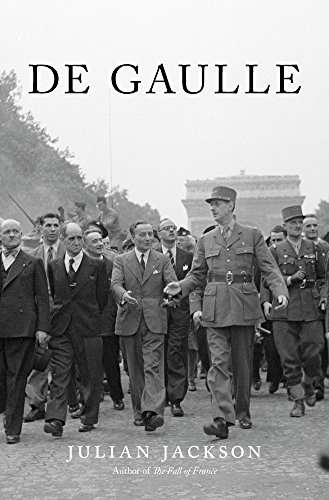

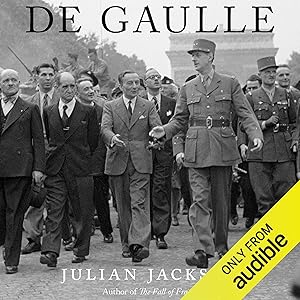

De Gaulle by Julian Jackson

De Gaulle

Julian Jackson
928 pages
Belknap Press
Jan 1971
History WSBN
3
Readers
1
Reviews
0
Discussions
0
Quotes
<p>A definitive biography of the mythic general who refused to accept the Nazi domination of France, drawing on unpublished letters, memoirs, and papers in the newly opened de Gaulle archives that show how this volatile and inspiring leader put his broken nation back at the center of world affairs.</p><p>In the early summer of 1940, when France was overrun by German troops, one junior general who had fought in the trenches in Verdun refused to accept defeat. He fled to London, where he took to the radio to address his compatriots back home. &quot;Whatever happens,&quot; he said, &quot;the flame of French resistance must not be extinguished and will not be extinguished.&quot; At that moment, Charles de Gaulle entered history.</p><p>For the rest of the war, de Gaulle insisted he and his Free French movement were the true embodiment of France. Through sheer force of personality he inspired French men and women to risk their lives to resist the Nazi occupation. Sometimes aloof but confident in his leadership, he quarreled violently with Churchill and Roosevelt. Yet they knew they would need his help to rebuild a shattered Europe. Thanks to de Gaulle, France was recognized as one of the victorious Allies when Germany was finally defeated. Then, as President of the Fifth Republic, he brought France to the brink of a civil war over his controversial decision to pull out of Algeria. He challenged American hegemony, took France out of NATO, and twice vetoed British entry into the European Community in his pursuit of what he called &quot;a certain idea of France.&quot;</p><p>Julian Jackson's magnificent biography, the first major reconsideration in over twenty years, captures this titanic figure as never before. Drawing on the extensive resources of the recently opened de Gaulle archives, Jackson reveals the conservative roots of de Gaulle's intellectual formation, sheds new light on his relationship with Churchill, and shows how he confronted riots at home and violent independence movements from the Middle East to Vietnam. No previous biography has so vividly depicted this towering figure whose legacy remains deeply contested.</p>
Join the conversation

No discussions yet. Join BookLovers to start a discussion about this book!

Readable and revelatory

This book well deserves all the praise it's been receiving. I'm old enough to remember de Gaulle as being often in the news when I was growing up, but a shade too young to have understood why he was so newsworthy, other than that he apparently relished annoying the US. This book shows what was special about him, warts and all, without hagiography. Many readers may learn here, as I did, that his youngest child had Down's syndrome, and that he was devoted to her throughout her 20 years of life. It also becomes clear that de Gaulle was something of an intellectual, both very fond of literature and quite well-read, qualities missing from how one usually imagines a general and also from the actual generals in de Gaulle's milieu. He was also able to deliver, from memory, long speeches not only in French but in Spanish and German -- and seemed to enjoy concealing how capable he was in English, too. At the same time, de Gaulle's Machiavellian talent for playing his rivals, allies and supporters off each other is amply documented. So is the fact that he was an unusual mix of both monarchist and decolonizer. Another motivation for reading the book was that a close family member is considering entering politics in Japan, and I was curious to see if de Gaulle's career and the obstacles he faced might hold any useful lessons. The book's discussions of the drafting of the Constitution of the 5th Republic, which was tailor-made for de Gaulle, were quite instructive. But overall, I doubt there's much scope for politicians to imitate him. First, he seems to have been truly a brilliant man, and few such people enter politics these days. More than that, his main force came from his almost religious identification of himself with the interests of France: despite some comparisons to Louis XIV, the name more often invoked by him and his contemporaries was that of Jeanne d'Arc. If the book has one limitation -- and, since it runs to almost 800 pages of main text as it is, one is gratef...

No quotes shared yet. Join BookLovers to share your favorite quotes!

Earn Points
Your voice matters. Every comment, review, and quote earns you reward points redeemable for Bitcoin.
Comment +5 pts Review +20 pts Quote +7 pts Upvote +1 pt
BookMatch Quiz
Find books similar to this one
About this book
Pages 928
Publisher Belknap Press
Published 1971
Readers 3