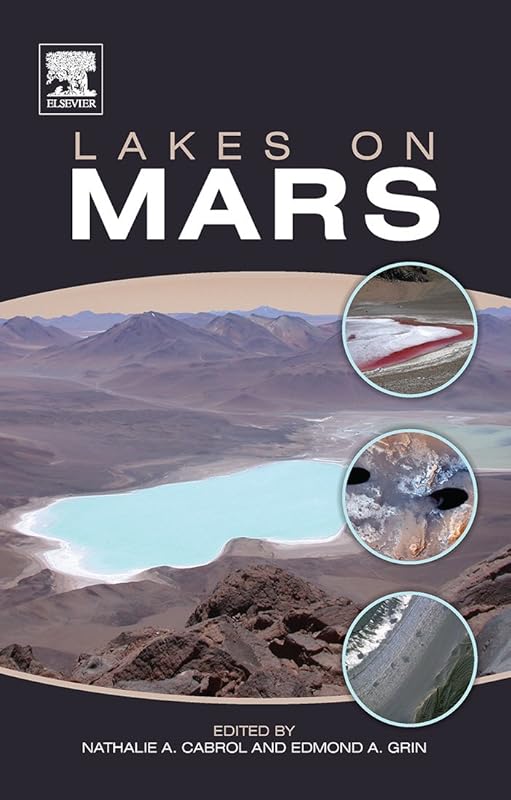
Lakes on Mars by Nathalie A. Cabrol

Lakes on Mars

Nathalie A. Cabrol
649 pages
Elsevier Science
Sep 2010
Hardcover
Science WSBN
0
Readers
0
Reviews
0
Discussions
0
Quotes
On Earth, lakes provide favorable environments for the development of life and its preservation as fossils. They are extremely sensitive to climate fluctuations and to conditions within their watersheds. As such, lakes are unique markers of the impact of environmental changes. Past and current missions have now demonstrated that water once flowed at the surface of Mars early in its history. Evidence of ancient ponding has been uncovered at scales ranging from a few kilometers to possibly that of the Arctic ocean. Whether life existed on Mars is still unknown; upcoming missions may find critical evidence to address this question in ancient lakebeds as clues about Mars' climate evolution and its habitability potential are still preserved in their sedimentary record.Lakes on Mars is the first review on this subject. It is written by leading planetary scientists who have dedicated their careers to searching and exploring the questions of water, lakes, and oceans on Mars through their involvement in planetary exploration, and the analysis of orbital and ground data beginning with Viking up to the most recent missions. In thirteen chapters, Lakes on Mars critically discusses new data and explores the role that water played in the evolution of the surface of Mars, the past hydrological provinces of the planet, the possibility of heated lake habitats through enhanced geothermal flux associated with volcanic activity and impact cratering. The book also explores alternate hypotheses to explain the geological record. Topographic, morphologic, stratigraphic, and mineralogic evidence are presented that suggest successions of ancient lake environments in Valles Marineris and Hellas. The existence of large lakes and/or small oceans in Elysium and the Northern Plains is supported both by the global distribution of deltaic deposits and by equipotential surfaces that may reflect their past margins. Whether those environments were conducive to life has yet to be demonstrated but from comparison with our planet, their sedimentary deposits may provide the best opportunity to find its record, if any. The final chapters explore the impact of climate variability on declining lake habitats in one of the closest terrestrial analogs to Mars at the Noachian/Hesperian transition, identify the geologic, morphologic and mineralogic signatures of ancient lakes to be searched for on Mars, and present the case for landing the Mars Science Laboratory mission in such an environment.First review on the subject by worldwide leading authorities in the fieldNew studies with most recent data, new images, figures, and mapsMost recent results from research in terrestrial analogs
Join the conversation

No discussions yet. Join BookLovers to start a discussion about this book!

No reviews yet. Join BookLovers to write the first review!

No quotes shared yet. Join BookLovers to share your favorite quotes!

Earn Points
Your voice matters. Every comment, review, and quote earns you reward points redeemable for Bitcoin.
Comment +5 pts Review +20 pts Quote +7 pts Upvote +1 pt
BookMatch Quiz
Find books similar to this one
About this book
Pages 649
Publisher Elsevier Science
Published 2010
Readers 0