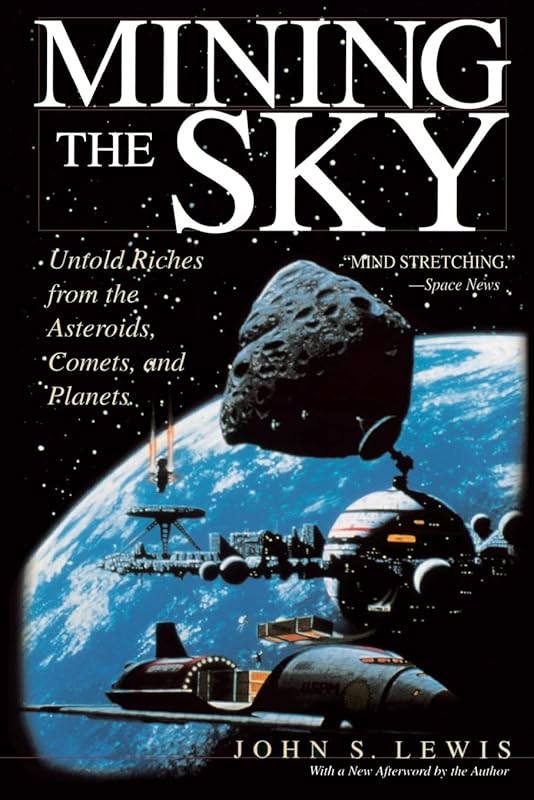


Mining the Sky: Untold Riches From The Asteroids, Comets, And Planets (Helix Book) by John S. Lewis

Mining the Sky: Untold Riches From The Asteroids, Comets, And Planets (Helix Book)

John S. Lewis
274 pages
Basic Books
Sep 1997
Paperback
Science WSBN
7
Readers
3
Reviews
1
Discussions
3
Quotes
While we worry over the depletion of the earth's natural resources, the pollution of our planet, and the challenges presented by the earth's growing population, billions of dollars worth of metals, fuels, and life-sustaining substances await us in nearby space. In this visionary book, noted planetary scientist John S. Lewis explains how we can mine these precious metals from the asteroids, comets, and planets in our own solar system for use in space construction projects. And this is just one of the possibilities. Join John S. Lewis as he contemplates milking the moons of Mars for water and hollowing out asteroids for space-bound homesteaders—all while demonstrating the economic and technical feasibility of plans that were once considered pure fiction.
America Exploration Future Program Russia Space
Lennart Lopin
Lennart Lopin
10 years ago

It's beautiful and impressive how well Lewis summarizes the history of space travel in the first chapters of his book, setting the stage for the main topic of his book. If you ever want to read a short but comprehensive summary of the history of American and Russian space pioneering, you will find it here as well.

Humankind's future in the solar system

An excellent book that has become one of my top three books on humankind's future in space in the near term. It starts out with an superb summary of human space travel thus far. That alone was a pleasure to read as it encompasses a lot of material in a very comprehensive manner. The book then switches gears and goes into exploring the very near term resources that surround Earth: the moon and near Earth asteroids. It keeps an eye on the economic feasibility of all of these explorations based on first principles: i.e. the potential resources vis-a-vis the fuel requirements that are needed and thus makes the case that space exploration can be "bootstrapped" even if we start with chemical propulsion to begin with. In the later chapters the book explores and illustrates the vast abundances of resources that are available to us in the Solar System (in particular the asteroid belt and Helium-3). Finally, it concludes with a firework: based on the (very conservative) numbers of resources that we know about it projects how one day hundreds of billions of people could potentially inhabit the Solar System while each living like 21st century billionaires quite easily. "Mining the Sky" is a powerful testament of what the human spirit might accomplish in the next couple of hundred years through further technological advances and by people who share John Lewis' vision of a brighter and abundant human future.

One of my favorites

This is one of my favorites…every human should read it

this book decided my life's pursuit!

Dr. Lewis without a doubt deserves to be one of the most influential leaders in space development. I found Mining the Sky by accident in a hometown book shop while in high school and bought it because I had a few dollars. Five years later, I'm 9 months away from becoming an Air Force space officer with an astronautics degree. This book is that impressive. This book is the clearest and accessible book on the economic impacts space will provide the human race to date. Most of its ideas aren't fanciful and can be easily imagined as maturing in the next 20-30 years or sooner, given an effort. Maybe even sooner, as at least one private company was inspired by Dr. Lewis' writings. Dr. Lewis' positive outlook is tempered by a realistic engineering and economic approach to space. Keep in mind this book is first and foremost about space industrialization, not exploration. A true space enthusaist should know that one cannot be without the other. Dr. Lewis could not have given a better general survey of whats out there. A brief addendum concerning other reviewers' criticisms. This book could be made much more technical. However, this book was meant to appeal to a large, nontechnical audience. For more information, see Dr. Lewis' earlier book (and parent to Mining the Sky) Resources of Near Earth Space. It is the standard text for space materials prospects. Mining the Sky is a toned down version of RoNES meant to explain to a layman (me, when I first read Mining) the opportunities that await those courageous enough to reach out. Thank you, Dr. Lewis. And everyone even remotely interested in space and mankinds future in it, READ THIS BOOK! Read more

We may choose either to retreat into a stagnant, shrinking future and play a zero-sum game on an exhausted planet or to expand into a vast new arena of activity, rich in material wealth and vibrant with energy, which will allow us both the freedom to escape the cradle and the resources to keep our home planet alive and well.
Page 11
The tools and dies for building the Saturns were collected and sold as scrap metal for pennies a pound; a $20 billion investment in the future was melted into dross.
Page 4
That humankind should have reached reached the mid-1990s without knowing how to grow food in space, how to deal with weightlessness, and how to counter the effects of cosmic radiation serves as a more powerful condemnation of the Soviet and American manned space programs from 1960 to 1995 than anything else a critic could say.
Page 62