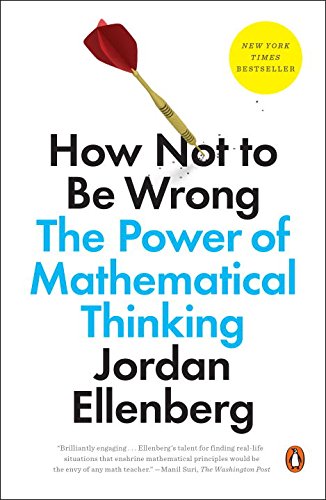
How Not to Be Wrong: The Power of Mathematical Thinking by Jordan Ellenberg

How Not to Be Wrong: The Power of Mathematical Thinking

Jordan Ellenberg
468 pages
Penguin Books
May 2015
Science WSBN
3
Readers
1
Reviews
0
Discussions
0
Quotes
<b>The <i>Freakonomics</i> of math - a math-world superstar unveils the hidden beauty and logic of the world and puts its power in our hands</b><br><br>The math we learn in school can seem like a dull set of rules, laid down by the ancients and not to be questioned. In <i>How Not to Be Wrong</i>, Jordan Ellenberg shows us how terribly limiting this view is: Math isn't confined to abstract incidents that never occur in real life, but rather touches everything we do - the whole world is shot through with it.<br><br>Math allows us to see the hidden structures underneath the messy and chaotic surface of our world. It's a science of not being wrong, hammered out by centuries of hard work and argument. Armed with the tools of mathematics, we can see through to the true meaning of information we take for granted: How early should you get to the airport? What does &quot;public opinion&quot; really represent? Why do tall parents have shorter children? Who really won Florida in 2000? And how likely are you, really, to develop cancer?<br><br><i>How Not to Be Wrong</i> presents the surprising revelations behind all of these questions and many more, using the mathematician's method of analyzing life and exposing the hard-won insights of the academic community to the layman - minus the jargon. Ellenberg chases mathematical threads through a vast range of time and space, from the everyday to the cosmic, encountering, among other things, baseball, Reaganomics, daring lottery schemes, Voltaire, the replicability crisis in psychology, Italian Renaissance painting, artificial languages, the development of non-Euclidean geometry, the coming obesity apocalypse, Antonin Scalia's views on crime and punishment, the psychology of slime molds, what Facebook can and can't figure out about you, and the existence of God.<br><br>Ellenberg pulls from history as well as from the latest theoretical developments to provide those not trained in math with the knowledge they need. Math, as Ellenberg says, is &quot;an atomic-powered prosthesis that you attach to your common sense, vastly multiplying its reach and strength.&quot; With the tools of mathematics in hand, you can understand the world in a deeper, more meaningful way. How Not to Be Wrong will show you how.
Join the conversation

No discussions yet. Join BookLovers to start a discussion about this book!

breezy trip through how a little mathematical thinking can clear things up

This is a book about mathematics but there is really very little mathematics in it. It is not about the history of mathematics either, though Dr. Ellenberg reaches throughout the book for some of the names and doings of that history to illustrate his themes. The theme is really the world, especially the social world, and how so much of what we experience is expressible mathematically, even if that expression comes not to a definite answer, but only a maybe or other equivocation. This is a book about getting us to think about the world's regularities and the claims of people in terms of the mathematics that can represent them. It turns out if you understand even the broad outlines of the mathematics you are in a much better position to analyze the claim or make the bet even if you do not (or cannot) actually DO the mathematics involved. A simple example tells the tale. We have all heard claims of the following sort: "the majority of Americans do not support X" (where X of course is just about anything at all of a social or political nature). Now it turns out that if you ask a whole lot of Americans three questions, questions about X, Y, and Z, and if roughly a third of the people asked are positive on one of the three and negative on the other two, it will turn out you can say with a straight face that a majority of Americans do not support X, Y, or Z, your choice, and you would be right! It is this sort of thing that "How Not to be Wrong" is really about. It is well written, not dry, enlightening (you will come away with a greater appreciation for mis-directed claims), and addresses much if not all of the social world we navigate daily. Enjoy Read more

No quotes shared yet. Join BookLovers to share your favorite quotes!

Earn Points
Your voice matters. Every comment, review, and quote earns you reward points redeemable for Bitcoin.
Comment +5 pts Review +20 pts Quote +7 pts Upvote +1 pt
BookMatch Quiz
Find books similar to this one
About this book
Pages 468
Publisher Penguin Books
Published 2015
Readers 3