Home/Books/Professional & Technical/
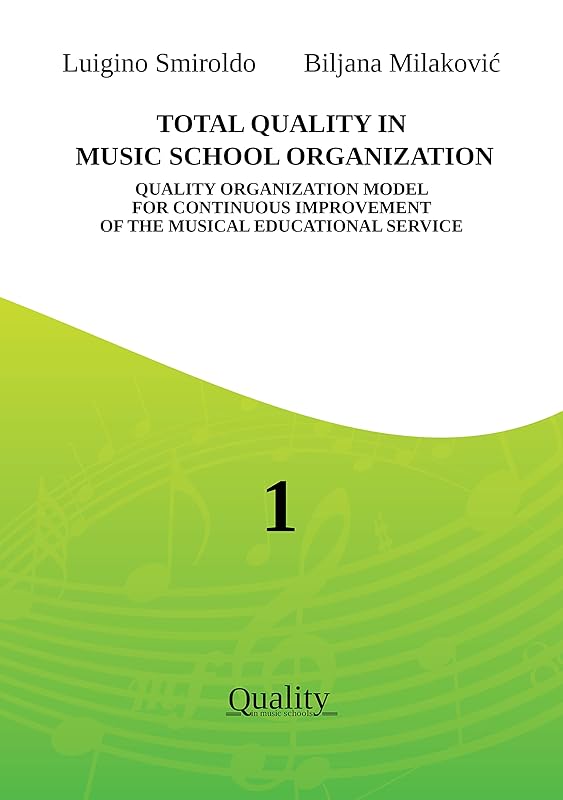
TOTAL QUALITY IN MUSIC SCHOOL ORGANIZATION : Quality organization model for continuos improvement of the musical educational service -Elementary and high music school-
TOTAL QUALITY IN MUSIC SCHOOL ORGANIZATION : Quality organization model for continuos improvement of the musical educational service -Elementary and high music school-
It is necessary to know the general aspects, complexities, and specificities that characterize a musical school organization if you want to move from a subjective and static convinction of the concept of "quality" to one based on objective, dynamic, measurable, and shared data. Hence the idea of offering the school management/leadership and the teaching staff an operational tool, complete with detailed documentation, on how to implement and proceed with the continuous improvement both for organizational efficiency and continuous improvement of the quality of the training service, offered to new generations of musicians.
To facilitate the understanding and operation of "how" a music school, private or public, should be organized in quality, we have ideally identified a "Music School Organization" made up of 1200 students from five to eighteen years old, divided into Primary Course and Secondary Course and which, moreover, has implemented an organized, organic, dynamic and synergistic system through Macro-processes, Processes with all related documentation.
To achieve what we set out to offer, we have adapted the models (Common Assessment Framework CAF2020 and CAF Education 2013 - European Foundation for Quality Management EFQM 2019) and the international regulations proposed to guarantee quality organization, transparency, safety, and quality of the artistic and cultural training service offered (ISO 9001: 2015 - ISO 14001: 2015 - ISO 45001:2018 - ISO 19011: 2018 - ISO 31000: 2018 - ISO 27001 - SA8000®: 2014) .
The educational offer of the art of playing a musical instrument to the new generations cannot remain passive and perched on training systems as if the world and society were the same as fifty years ago. We have ideally identified the needs and expectations of 21st-century students, in their and their families' different ages, aware of the fast and intense society transformation processes, including opportunities that innovation offers in music education as well.
We are also aware of what the global interconnection between telecommunications and computer networks offers in terms of knowledge, listening, and dissemination of musical art, now increasingly synergistic and integrated, and which has changed the need to learn the study of musical instrument-making the stakeholders, internal and external, more aware, more attentive, more demanding and more selective. Orchestras that have to promote an ever-wider repertoire have changed their needs and their members must be increasingly prepared. The competitiveness, the complexity, and the difficulty of having an individual artistic success have increased. Competitiveness has increased between musical school organizations and between universities. Relationships with other organizations have increased to achieve their strategic goals.
The help of the documentation of all the Processes, Operating Procedures, Modules, Operating Instructions, Questionnaires, and Check-lists correlated by flow charts, figures, tables, and simplifying examples, allows school Leadership to completely develop their project of reorganization or improvement and, above all, it can have the whole system in its entirety clear in advance. Furthermore, it can also be used to plan dedicated training courses by extrapolating the 160 figures proposed and graphically elaborated.
We desire to contribute to a high musical education artistic level for future generations of musicians.
Music education leads students to a concrete and critical approach to the world of sound and music. Taking into consideration the sensitivity and pleasure of "making" music and listening to it, provides students with the cultural and technical knowledge necessary for the development of their listening and expression skills. Mobilizing the body in musical gestures contributes to physical and psychological balance. Read more Continue reading Read less