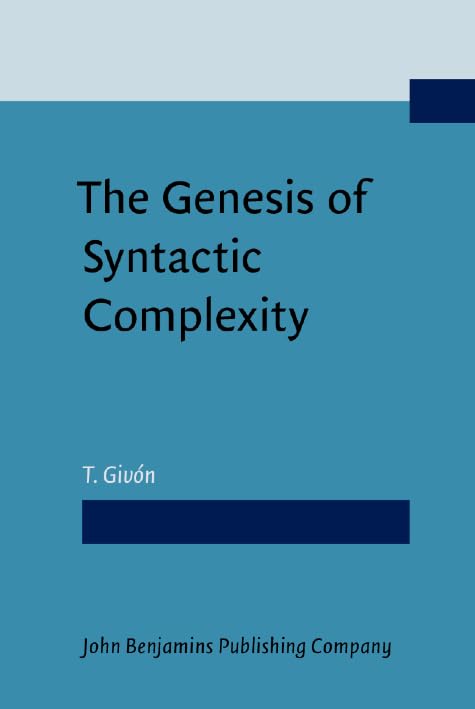
The Genesis of Syntactic Complexity: Diachrony, ontogeny, neuro-cognition, evolution by T. Givón

The Genesis of Syntactic Complexity: Diachrony, ontogeny, neuro-cognition, evolution

T. Givón
384 pages
John Benjamins Publishing Company
Feb 2009
Hardcover
All Non-Fiction WSBN
0
Readers
0
Reviews
0
Discussions
0
Quotes
Complex hierarchic syntax is a hallmark of human language. The highest level of syntactic complexity, recursive-embedded clauses, has been singled out by some for a special status as the evolutionary apex of the uniquely - human language faculty - evolutionary yet mysteriously immune to Darwinian adaptive selection. Prof. Givón's book treats syntactic complexity as an integral part of the evolutionary rise of human communication. The book first describes grammar as an adaptive instrument of communication, assembled upon the pre-existing platform of pre-linguistic object- and-event cognition and mental representation. It then surveys the two grand developmental trends of human language: diachrony, the communal enterprise directly responsible for fashioning synchronic morpho-syntax and cross-language diversity; and ontogeny, the individual endeavor directly responsible for acquiring the competent use of grammar. The genesis of syntactic complexity along these two developmental trends is compared with second language acquisition, pre-grammatical pidgin and pre-human communication. The evolutionary relevance of language diachrony, language ontogeny and pidginization is argued for on general bio-evolutionary grounds: It is the organism's adaptive on-line behavior- invention, learning and skill acquisition - that is the common thread running through all three developmental trends. The neuro-cognitive circuits that underlie language, and their evolutionary underpinnings, are described and assessed. Recursive embedding turns out to be not an adaptive target on its own, but the by-product of two distinct adaptive moves: (i) the recruitment of conjoined clauses as modal operators on, or referential specifiers of, other clauses; and (ii) the subsequent condensation of paratactic into syntactic structures.
Join the conversation

No discussions yet. Join BookLovers to start a discussion about this book!

No reviews yet. Join BookLovers to write the first review!

No quotes shared yet. Join BookLovers to share your favorite quotes!

Earn Points
Your voice matters. Every comment, review, and quote earns you reward points redeemable for Bitcoin.
Comment +5 pts Review +20 pts Quote +7 pts Upvote +1 pt
BookMatch Quiz
Find books similar to this one
About this book
Pages 384
Publisher John Benjamins Publi...
Published 2009
Readers 0