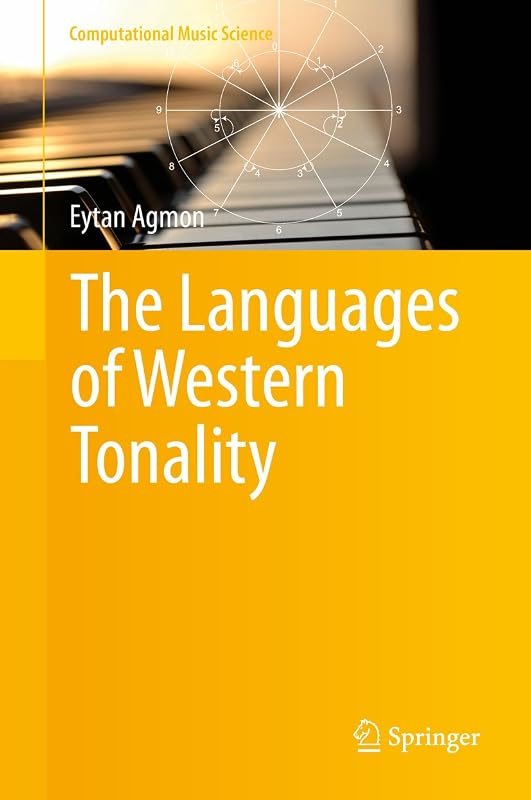
The Languages of Western Tonality (Computational Music Science) by Eytan Agmon

The Languages of Western Tonality (Computational Music Science)

Eytan Agmon
308 pages
Springer
Nov 2013
Hardcover
Computers & Internet WSBN
0
Readers
0
Reviews
0
Discussions
0
Quotes
Tonal music, from a historical perspective, is far from homogenous; yet an enduring feature is a background "diatonic" system of exactly seven notes orderable cyclically by fifth. What is the source of the durability of the diatonic system, the octave of which is representable in terms of two particular integers, namely 12 and 7? And how is this durability consistent with the equally remarkable variety of musical styles - or languages - that the history of Western tonal music has taught us exist? . This book is an attempt to answer these questions. Using mathematical tools to describe and explain the Western musical system as a highly sophisticated communication system, this theoretical, historical, and cognitive study is unprecedented in scope and depth. The author engages in intense dialogue with 1000 years of music-theoretical thinking, offering answers to some of the most enduring questions concerning Western tonality. . The book is divided into two main parts, both governed by thecommunicative premise. Part I studies proto-tonality, the background system of notes prior to the selection of a privileged note known as "final." After some preliminaries that concern consonance and chromaticism, Part II begins with the notion "mode." A mode is "dyadic" or "triadic," depending on its "nucleus." Further, a "key" is a special type of "semi-key" which is a special type of mode. Different combinations of these categories account for tonal variety. Ninth-century music, for example, is a tonal language of dyadic modes, while seventeenth-century music is a language of triadic semi-keys.. While portions of the book are characterized by abstraction and formal rigor, more suitable for expert readers, it will also be of value to anyone intrigued by the tonal phenomenon at large, including music theorists, musicologists, and music-cognition researchers. The content is supported by a general index, a list of definitions, a list of notation used, and two appendices providing the basic mathematical background.
Join the conversation

No discussions yet. Join BookLovers to start a discussion about this book!

No reviews yet. Join BookLovers to write the first review!

No quotes shared yet. Join BookLovers to share your favorite quotes!

Earn Points
Your voice matters. Every comment, review, and quote earns you reward points redeemable for Bitcoin.
Comment +5 pts Review +20 pts Quote +7 pts Upvote +1 pt
BookMatch Quiz
Find books similar to this one
About this book
Pages 308
Publisher Springer
Published 2013
Readers 0