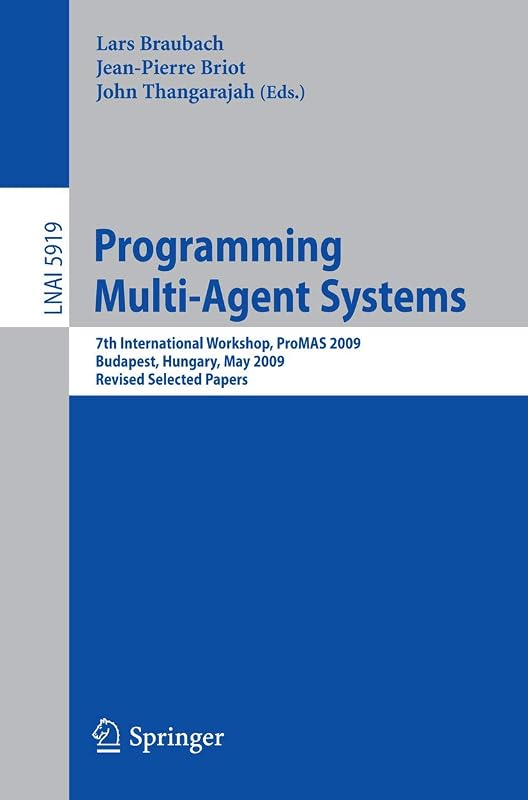
Programming Multi-Agent Systems: 7th International Workshop, ProMAS 2009, Budapest, Hungary, May10-15, 2009.Revised Selected Papers (Lecture Notes in Computer Science, 5919) by Lars Braubach

Programming Multi-Agent Systems: 7th International Workshop, ProMAS 2009, Budapest, Hungary, May10-15, 2009.Revised Selected Papers (Lecture Notes in Computer Science, 5919)

Lars Braubach
297 pages
Springer
Sep 2010
Paperback
Computers & Internet WSBN
0
Readers
0
Reviews
0
Discussions
0
Quotes
The earliest work on agents may be traced at least to the ?rst conceptualization of the actor model by Carl Hewitt. In a paper in an AI conference in the early 1970s, Hewitt described actors as entities with knowledge and goals. Research on actors continued to focus on AI with the development of the Sprites model in which a monotonically growing knowledge base could be accessed by actors (inspired by what Hewitt called "the Scienti?c Computing Metaphor") . In the late1970sandwellinto 1980s,controversyragedinAIbetweenthosearguingfor declarative languages and those arguing for procedural ones. Actor researchers stood on the side of a procedural view of knowledge, arguing for an open s- tems perspective rather than the closed world hypothesis necessary for a logical, declarativeview. In the open systemsview,agentshad armslength relationships and could not be expected to store consistent facts, nor could the information in a system be considered complete (the "negation as failure" model) . Subsequent work on actors, including my own, focused on using actors for general purpose concurrent and distributed programming. In the late 1980s, a number of actor languages and frameworks were built. These included Act++ (in C++) by Dennis Kafura and Actalk (in Smalltalk) by Jean-Pierre Briot. In recent times, the use of the Actor model, in various guises, has proliferated as new parallel and distributed computing platforms and applications have become common:clusters,Webservices,P2Pnetworks,clientprogrammingonmulticore processors, and cloud computing.
Join the conversation

No discussions yet. Join BookLovers to start a discussion about this book!

No reviews yet. Join BookLovers to write the first review!

No quotes shared yet. Join BookLovers to share your favorite quotes!

Earn Points
Your voice matters. Every comment, review, and quote earns you reward points redeemable for Bitcoin.
Comment +5 pts Review +20 pts Quote +7 pts Upvote +1 pt
BookMatch Quiz
Find books similar to this one
About this book
Pages 297
Publisher Springer
Published 2010
Readers 0