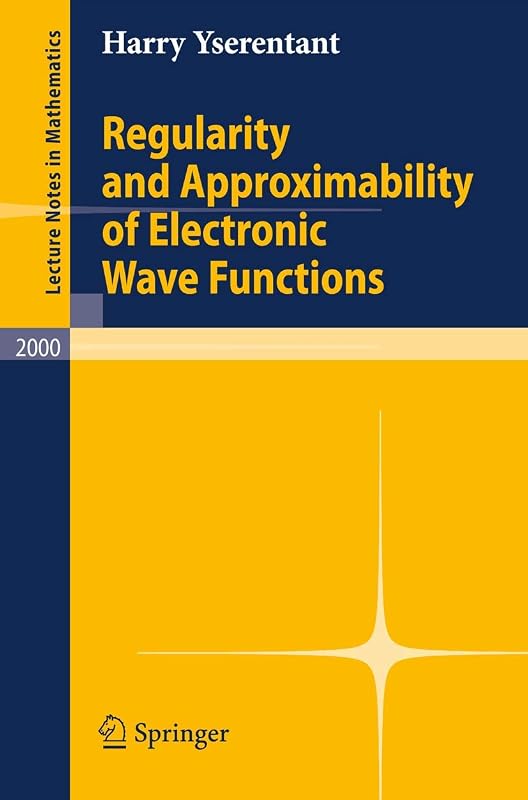
Regularity and Approximability of Electronic Wave Functions (Lecture Notes in Mathematics, 2000) by Harry Yserentant

Regularity and Approximability of Electronic Wave Functions (Lecture Notes in Mathematics, 2000)

Harry Yserentant
196 pages
Springer
Jun 2010
2010th Edition
Computers & Internet WSBN
0
Readers
0
Reviews
0
Discussions
0
Quotes
The electronic Schrodi ¨ nger equation describes the motion of N electrons under Coulomb interaction forces in a eld of clamped nuclei. Solutions of this equation depend on 3N variables, three spatial dimensions for each electron. Approxim- ing the solutions is thus inordinately challenging, and it is conventionally believed that a reduction to simpli ed models, such as those of the Hartree-Fock method or density functional theory, is the only tenable approach. This book seeks to c- vince the reader that this conventional wisdom need not be ironclad: the regularity of the solutions, which increases with the number of electrons, the decay behavior of their mixed derivatives, and the antisymmetry enforced by the Pauli principle contribute properties that allow these functions to be approximated with an order of complexity which comes arbitrarily close to that for a system of one or two electrons. The present notes arose from lectures that I gave in Berlin during the academic year 2008/09 to introduce beginning graduate students of mathematics into this subject. They are kept on an intermediate level that should be accessible to an audience of this kind as well as to physicists and theoretical chemists with a c- responding mathematical training.
Join the conversation

No discussions yet. Join BookLovers to start a discussion about this book!

No reviews yet. Join BookLovers to write the first review!

No quotes shared yet. Join BookLovers to share your favorite quotes!

Earn Points
Your voice matters. Every comment, review, and quote earns you reward points redeemable for Bitcoin.
Comment +5 pts Review +20 pts Quote +7 pts Upvote +1 pt
BookMatch Quiz
Find books similar to this one
About this book
Pages 196
Publisher Springer
Published 2010
Readers 0