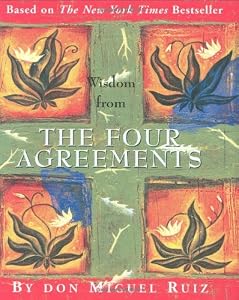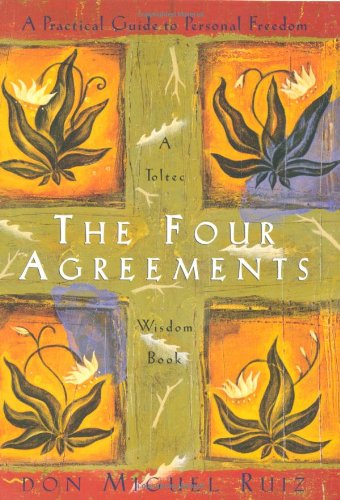
The Four Agreements: A Practical Guide to Personal Freedom by Don Miguel Ruiz

The Four Agreements: A Practical Guide to Personal Freedom

Don Miguel Ruiz
Amber-Allen Publishing
Nov 1997
WSBN
4
Readers
1
Reviews
0
Discussions
0
Quotes
Rooted in traditional Toltec wisdom beliefs, four agreements in life are essential steps on the path to personal freedom. As beliefs are transformed through maintaining these agreements, shamanic teacher and healer don Miguel Ruiz asserts lives will "become filled with grace, peace, and unconditional love."
Join the conversation

No discussions yet. Join BookLovers to start a discussion about this book!

This is not "new age" self help book! This book is based on modern linguistic theory and philosophic

I should start off by stating my background. I am an undergrad student of philosophy and linguistics, a branch of the humanities. I also deeply love this series of books because of its obviousness and simplicity. It has personally helped me triumph over many, many challenges. This is why I decided to write a review here. There is a huge tradition of skepticism in linguistics, especially about how language is used in various cultures to create belief systems. A belief system is basically a set of instructions inside your brain based on language. These instructions help you navigate the stressful world around you so you can survive. We are psychologically wired to think our belief systems are accurate and experience deep stress if we find them to be inaccurate. The trouble is, our belief systems are ALWAYS inaccurate. Yes, I used the word "always" for a reason. Without going deeply into the study of philosophy and linguistics, I will give you an overview here: Philosophy - When you study philosophy, you study belief systems about how the world works and explore important questions like "is there a God?" or "What is consciousness." You may not be surprised to find out that philosophy majors have not come up with answers to these questions because there is always a case where we are going to be wrong or have a counter argument. Much of the study of philosophy is the collection of vocabulary words to describe beliefs. They even have a mathematical component called propositional logic, where one takes sentences and reduces them to symbols and creates "proofs" but even prop-logic is under fire from academics for its complete inability to predict anything. In other words, it isn't the answer either. Linguistics - When you study words and language, you realize that all our beliefs are based on language and this language can never "touch reality" in that language is just an arbitrary description of reality, posing as real. I believe Miguel Ruiz must have taken a linguistic...

No quotes shared yet. Join BookLovers to share your favorite quotes!

Earn Points
Your voice matters. Every comment, review, and quote earns you reward points redeemable for Bitcoin.
Comment +5 pts Review +20 pts Quote +7 pts Upvote +1 pt
BookMatch Quiz
Find books similar to this one
About this book
Publisher Amber-Allen Publishi...
Published 1997
Readers 4