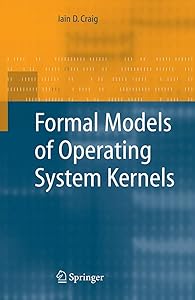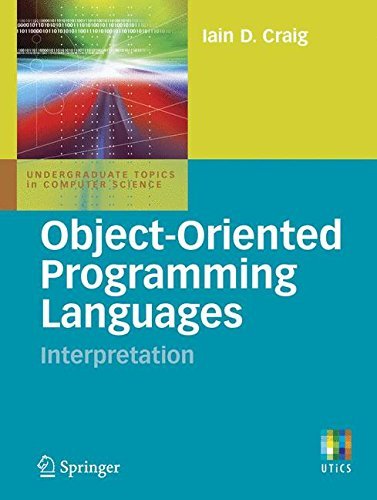
Object-Oriented Programming Languages: Interpretation (Undergraduate Topics in Computer Science) by Iain D. Craig

Object-Oriented Programming Languages: Interpretation (Undergraduate Topics in Computer Science)

Iain D. Craig
264 pages
Springer
Jul 2007
Hardcover
Default WSBN
0
Readers
0
Reviews
0
Discussions
0
Quotes
1.1 Introduction Object-oriented programming has opened a great many perspectives on the concept of software and has been hailed as part of the solution to the so-called "software crisis". It has given the possibility that software components can be constructedandreusedwithconsiderablymorecredibility.Therearenowmany case studies in which the reuse of object-oriented components has been made and analysed. Object-oriented programming relates the programming activity to that of modelling or simulation; objects are identi?ed by a correspondence with the objects found in the application area of the program and are used to model those domain operations. Object-oriented programming also opens the prospect of more ?exible software that is able to respond dynamically to the needs of the application at runtime. It is very easy to think that object-oriented programming can be performed in only one way. The prevalence of C++ and Java suggests that they are the onlywaytoapproachtheproblemofwhatanobject-orientedprogrammingl- guage should look like. There are many approaches to this way of programming andC++andJavaexemplifyjustoneofthesedi?erentapproaches.Indeed,the wayinwhichtheconceptoftheobjectisinterpreteddi?ersbetweenapproaches and between languages. The two main approaches found in object-oriented programming languages are, respectively, class-based and prototype-based languages. Class-based l- guages are exempli?ed by Smalltalk [34], C++ [75, 74] and Java [47]. This 2 1. Introduction approach is based upon the identi?cation of common properties of objects and their description in terms of a de?nitional structure called a class. The objects manipulated by class-based programs are the result of instantiating classes.
Join the conversation

No discussions yet. Join BookLovers to start a discussion about this book!

No reviews yet. Join BookLovers to write the first review!

No quotes shared yet. Join BookLovers to share your favorite quotes!

Earn Points
Your voice matters. Every comment, review, and quote earns you reward points redeemable for Bitcoin.
Comment +5 pts Review +20 pts Quote +7 pts Upvote +1 pt
BookMatch Quiz
Find books similar to this one
About this book
Pages 264
Publisher Springer
Published 2007
Readers 0