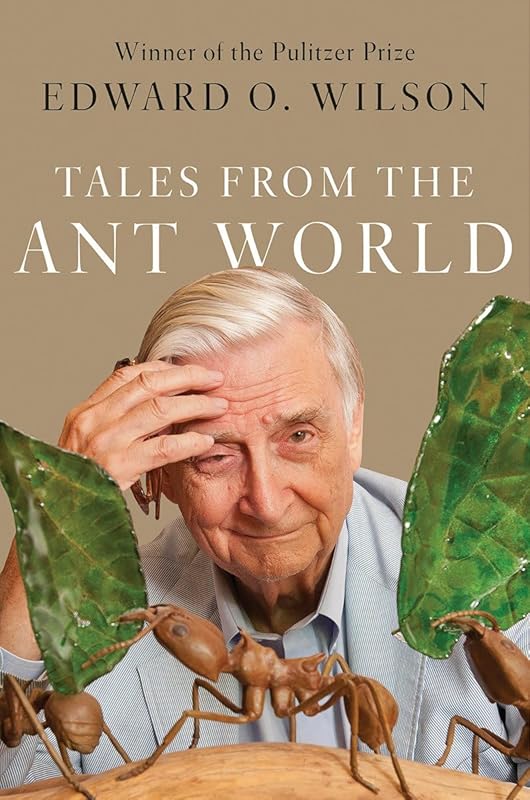
Tales from the Ant World by Edward O. Wilson

Tales from the Ant World

Edward O. Wilson
240 pages
Liveright
Aug 2020
Hardcover
All Non-Fiction WSBN
1
Readers
0
Reviews
2
Discussions
10
Quotes
Edward O. Wilson recalls his lifetime with ants, from his first boyhood encounters in the woods of Alabama to perilous journeys into the Brazilian rainforest."Ants are the most warlike of all animals, with colony pitted against colony," writes E.O. Wilson, one of the world's most beloved scientists, "their clashes dwarf Waterloo and Gettysburg." In Tales from the Ant World, two-time Pulitzer Prize-winner Wilson takes us on a myrmecological tour to such far-flung destinations as Mozambique and New Guinea, the Gulf of Mexico's Dauphin Island and even his parent's overgrown backyard, thrillingly relating his nine-decade-long scientific obsession with over 15,000 ant species.Animating his scientific observations with illuminating personal stories, Wilson hones in on twenty-five ant species to explain how these genetically superior creatures talk, smell, and taste, and more significantly, how they fight to determine who is dominant. Wryly observing that "males are little more than flying sperm missiles" or that ants send their "little old ladies into battle," Wilson eloquently relays his brushes with fire, army, and leafcutter ants, as well as more exotic species. Among them are the very rare Matabele, Africa's fiercest warrior ants, whose female hunters can carry up to fifteen termites in their jaw (and, as Wilson reports from personal experience, have an incredibly painful stinger) ; Costa Rica's Basiceros, the slowest of all ants; and New Caledonia's Bull Ants, the most endangered of them all, which Wilson discovered in 2011 after over twenty years of presumed extinction.Richly illustrated throughout with depictions of ant species by Kristen Orr, as well as photos from Wilsons' expeditions throughout the world, Tales from the Ant World is a fascinating, if not occasionally hair-raising, personal account by one of our greatest scientists and a necessary volume for any lover of the natural world. 28 black-and-white images
Join the conversation
Lennart Lopin
Lennart Lopin
2 years ago

Reading all these group selection statements makes me wonder what Richard Dawkins would have to say…

Yanina Lopin
Yanina Lopin
2 years ago

Biology is the study of complicated things that have the appearance of having been designed with a purpose. Richard Dawkins

No reviews yet. Join BookLovers to write the first review!

The strange world of the army ants and their symbiotic guests reminds us of an important principle of parasite biology - practiced by creatures ranging from disease causing bacteria to human criminals - that the most successful parasite is the one that causes the least damage.
Page 42
Only the bold and brave would think of walking up to a bull ant nest and start to excavate it. Under normal circumstances, it would be like taking apart a hornet paper nest layer by layer.
Page 65
The general principle of evolution emerging from the military strategy of ant colonies is the following: the more defensible a nest site and the more valuable the resources it contains, the more powerful the defense and the greater the fierceness with which it is applied.
Page 68
If advanced forms of life are found … the aliens will most likely include eusocial species of some kind, by definition those in which societies are formed by means of altruism and advanced degrees of cooperation… The workers, freed partly … [from] necessities or reproduction, are able to specialize and compete more effectively, enabling the colony to outcompete individuals or other colonies. Evolution then proceeds by natural selection, not just among individual members … but also colonies. … the unit of evolution is the gene, and the target of natural selection is the trait prescribed by the gene. That is all that matters in fundamental Darwinian biology, likely to be a law throughout the universe.
Page 80
Eusocial colonies have arisen at least seventeen times in the history of life on Earth.
Page 81
…all the living ants weigh about the same as all the living humans.
Page 82
The body odor of an individual ant, a mix of scents absorbed into its body oils, is like the face of a person or the uniform he or she may be wearing. The combination of chemical compounds it carries allows other ants of the same species to tell at an olfactory glance whether it is a member of the same colony or not, its gender, physical caste, approximate age, and the task for which it is specialized at the moment.
Page 84
Can one ant species “read” the pheromone language of another? In some cases they can, and the capacity to do so opens the door to their victimization by social parasitism.
Page 99
The idea, if I might use that word, is to twist the instinctive behavior of the host enough so that the parasite, not the victim, receives the benefit of better survival and more reproduction.
Page 140
One consequence of this division crafted for unity is that the colony, in addition to each of its members, is a unit of evolution. As a colony changes over time, it competes with other colonies of the same species living around it. The result is natural selection at the colony level. Some social traits, such as altruism and bravery in battle, are shaped by “group selection”; in other words “colony versus colony” leads workers to do what’s best for the group.
Page 200
Earn Points
Your voice matters. Every comment, review, and quote earns you reward points redeemable for Bitcoin.
Comment +5 pts Review +20 pts Quote +7 pts Upvote +1 pt
BookMatch Quiz
Find books similar to this one
About this book
Pages 240
Publisher Liveright
Published 2020
Readers 1