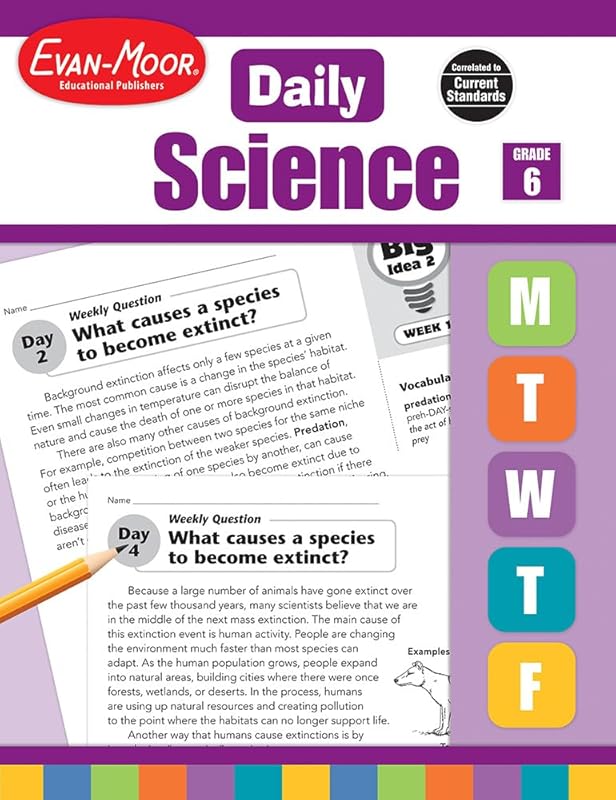
Daily Science: Grade 6+ (Daily Practice Books) by Evan-Moor Educational Publishers

Daily Science: Grade 6+ (Daily Practice Books)

Evan-Moor Educational Publishers
192 pages
Evan-Moor Educational Publishers
Apr 2010
Paperback
All Non-Fiction WSBN
0
Readers
0
Reviews
0
Discussions
0
Quotes
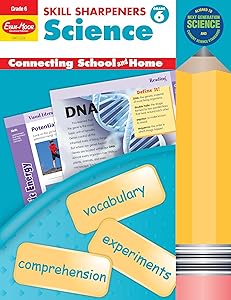
Science can still be fun in middle school. The concepts are more involved, but students can learn the scientific concepts and vocabulary of life, physical and Earth science innovatively with Daily Science from Evan-Moor. This science activity print teacher s edition is ideal for grades six, delivering 150 lessons on vital science standards. Each week is divided into interesting units that include hands-on science activities, important science vocabulary and more. Students will explore intriguing scientific questions like why some people are left-handed and why crocodiles have survived for millions of years. The lessons easily add to any middle school science curriculum.Fit standards-based science instruction into your curriculum!Help your grade 6 students develop a genuine understanding of standards-based scientific concepts and vocabulary using the 150 engaging activities in Daily Science! A variety of rich resources, including vocabulary practice, hands-on science activities, and comprehension tests in multiple-choice format, help you successfully introduce students to earth, life, and physical science concepts.30 weeks of instruction cover the following standards-based science topics:Big Idea 1: Living things are made mostly of cells. Multicellular organisms have different cells that perform specialized functionsWeek 1: Can horses and zebras have babies together?Week 2: Why are some people left-handed?Week 3: How can corn be yellow, white, or blue?Week 4: Are identical twins exactly alike?Week 5: Unit ReviewBig Idea 2: Changes in the environment can affect the survival of a speciesWeek 1: What causes a species to become extinct?Week 2: How have crocodiles survived for millions of years?Week 3: If the ice cap melts, why can't polar bears just adapt?Week 4: Would humans survive if there was another ice age?Week 5: Unit ReviewBig Idea 3: The tilt of Earth's axis and energy from the sun affect seasons and weather patternsWeek 1: What causes the weather?Week 2: Why don't hurricanes happen at the equator?Week 3: Why are the North and South Poles so cold?Week 4: Are the seasons reversed on the other side of the world?Week 5: Unit ReviewBig Idea 4: Earth is divided into layers: crust, mantle, and core. The crust is made up of plates and move slowly around the Earth's surfaceWeek 1: Why do the continents look like they fit together?Week 2: How do scientists know what is inside Earth?Week 3: What happens when two continents collide?Week 4: What will Earth's surface look like in the future?Week 5: Unit ReviewBig Idea 5: Matter is made up of tiny particles called atoms. Different arrangements of atoms compose all substancesWeek 1: What do atoms look like?Week 2: What is the periodic table?Week 3: What is water made of?Week 4: How are living things different from nonliving things?Week 5: Unit ReviewBig Idea 6: Energy can be mechanical, electrical, thermal, or chemicalWeek 1: How do windmills make electricity?Week 2: What makes popcorn pop?Week 3: What makes fireflies glow?Week 4: How do fireworks work?Week 5: Unit Review
Join the conversation

No discussions yet. Join BookLovers to start a discussion about this book!

No reviews yet. Join BookLovers to write the first review!

No quotes shared yet. Join BookLovers to share your favorite quotes!

Earn Points
Your voice matters. Every comment, review, and quote earns you reward points redeemable for Bitcoin.
Comment +5 pts Review +20 pts Quote +7 pts Upvote +1 pt
BookMatch Quiz
Find books similar to this one
About this book
Pages 192
Publisher Evan-Moor Educationa...
Published 2010
Readers 0