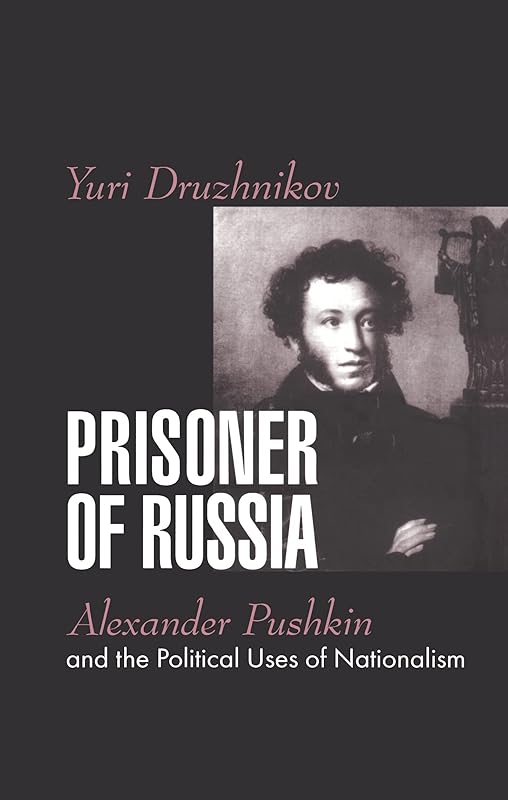
Prisoner of Russia: Alexander Pushkin and the Political Uses of Nationalism by Yuri Druzhnikov

Prisoner of Russia: Alexander Pushkin and the Political Uses of Nationalism

Yuri Druzhnikov
466 pages
Routledge
Apr 1999
1st Edition
Literature & Fiction WSBN
0
Readers
0
Reviews
0
Discussions
0
Quotes
As the central figure in Russian literature, Alexander Pushkin (1799û1837) has been claimed by nearly every political faction, right and left, in Russian cultural politics over the past two centuries, culminating in his official canonization under the Soviet regime. In Prisoner of Russia, Yuri Druzhnikov analyzes the distortions and misrepresentations of Pushkin's cultural appropriation by focusing on Pushkin's attempts at emigration and his attitudes toward Russia and Western Europe.Druzhnikov's semi-biographical narrative concentrates on Pushkin's attempts to leave Russia after his graduation from the Lyceum, through his period of exile, until his early death in a duel in 1837. The matter of emigration from Russia was a politically charged issue well before 1917; witness the hostile reception of all of Turgenev's novels from Fathers and Sons on. The emigrÚ artist's cultural context is often used to assess his authenticity and stature as seen in the Western examples of Henry James, T.S. Eliot, or James Joyce. Druzhnikov sharply criticizes the omnipresent and reductive tendency in Russia (and the West) to define Russian cultural figures in terms of absolute essences and ideologies and to ignore the ambivalences that in fact help to define a writer's singularity. In the larger view, he argues, it is these that explain the variety and complexity of Russian culture.Druzhnikov's multidisciplinary approach combines literary and political history, with critical commentary arranged in chronological sequence. His interpretive apparatus ranges widely through nineteenth- and twentieth-century history, and provides the necessary intellectual context for nonspecialist readers. He also avoids the massive accumulation of trivial detail characteristic of so much Pushkinology. This accessible, valuable exercise in cultural history will be of interest to Slavic scholars and students, cultural historians, and general readers interested in Russian literature and culture.
Join the conversation

No discussions yet. Join BookLovers to start a discussion about this book!

No reviews yet. Join BookLovers to write the first review!

No quotes shared yet. Join BookLovers to share your favorite quotes!

Earn Points
Your voice matters. Every comment, review, and quote earns you reward points redeemable for Bitcoin.
Comment +5 pts Review +20 pts Quote +7 pts Upvote +1 pt
BookMatch Quiz
Find books similar to this one
About this book
Pages 466
Publisher Routledge
Published 1999
Readers 0