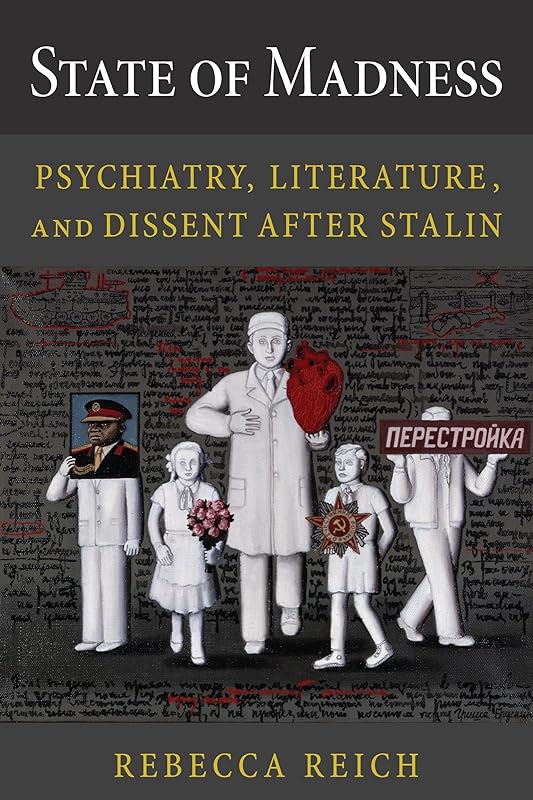
State of Madness: Psychiatry, Literature, and Dissent After Stalin (NIU Series in Slavic, East European, and Eurasian Studies) by Rebecca Reich

State of Madness: Psychiatry, Literature, and Dissent After Stalin (NIU Series in Slavic, East European, and Eurasian Studies)

Rebecca Reich
300 pages
Northern Illinois University Press
Aug 2022
Paperback
Psychology & Philosophy WSBN
0
Readers
0
Reviews
0
Discussions
0
Quotes
What madness meant was a fiercely contested question in Soviet society. State of Madness examines the politically fraught collision between psychiatric and literary discourses in the years after Joseph Stalin's death. State psychiatrists deployed set narratives of mental illness to pathologize dissenting politics and art. Dissidents such as Aleksandr Vol'pin, Vladimir Bukovskii, and Semen Gluzman responded by highlighting a pernicious overlap between those narratives and their life stories. The state, they suggested in their own psychiatrically themed texts, had crafted an idealized view of reality that itself resembled a pathological work of art. In their unsanctioned poetry and prose, the writers Joseph Brodsky, Andrei Siniavskii, and Venedikt Erofeev similarly engaged with psychiatric discourse to probe where creativity ended and insanity began. Together, these dissenters cast themselves as psychiatrists to a sick society. By challenging psychiatry's right to declare them or what they wrote insane, dissenters exposed as a self-serving fiction the state's renewed claims to rationality and modernity in the post-Stalin years. They were, as they observed, like the child who breaks the spell of collective delusion in Hans Christian Andersen's story "The Emperor's New Clothes." In a society where normality means insisting that the naked monarch is clothed, it is the truth-teller who is pathologized. Situating literature's encounter with psychiatry at the center of a wider struggle over authority and power, this bold interdisciplinary study will appeal to literary specialists; historians of culture, science, and medicine; and scholars and students of the Soviet Union and its legacy for Russia today.

Read more Continue reading Read less REVIEW
The inherent slipperiness of diagnostic categories such as 'schizophrenia' is the subject of Rebecca Reich's fascinating and impressively nuanced new study.

-- Times Literary Supplement

Reich's work is a significant contribution to both the literary discourse of mental illnesses and the literary interpretations of the Soviet 'different thinkers' of the post-Stalin era. It is a well-structured book which effectively proves its premises, sustaining the readers' interest until the end by illustrating the literary analyses with medical interviews and biographical episodes.

-- Canadian Slavonic Papers

[Reich] offers a new and sophisticated take on the subject by approaching it from the perspectives of literature and of dissenters' engagement with the psychiatric discourse.... her book makes a valuable contribution to the understanding of punitive psychiatry and dissent in the USSR

-- History of Psychiatry

By applying a formal literary analysis to clinical documents, Reich convincingly demonstrates that the discipline of psychiatry was structured according to an 'established aesthetic framework' borrowing from the 'literary doctrine of Socialist Realism.' Psychiatrists framed their diagnostic practices as a kind of artistic endeavour and pathologised aesthetic modes that deviated from the standards of Socialist Realism.

-- History of the Human Sciences

With readings of both psychiatric and literary texts through cultural studies lenses, Reich has illuminated the literary discourse that permeated psychiatric reasoning during the period. She makes a vital contribution to the study of this feature of the Soviet police state after Stalin.

-- Isis

Psychiatric incarceration as a form of repression against dissidents belongs to the staples of the history of the Soviet human rights movement. Rebecca Reich's study contributes to a reexamination of this question from an interdisciplinary perspective, as she navigates skillfully among the literary, historical, and medical realms.

-- Kritika

A fascinating study.... While socially and politically specific, the exploration of psychiatric abuse and dissident responses also benefits in Reich's interdisciplinary study from a longer perspective that considers the theme of madness in the Russian literary tradition.

-- Slavic Review

In this historically-framed, detail-rich literary analysis of the understanding and influence of psychiatry in the Soviet Union after Stalin, Reich offers an excellent starting point for, and lasting contribution to, our understanding of the transition of Soviet society in the second half of the twentieth century.

-- The Russian Review

At times zooming in to the level of parts of speech in a poem, at others expanding outward to the broad historical factors at work in the post-Stalin era, Reich offers a thorough and engrossing story of this battle of wills fought in examination rooms and in samizdat publications.

-- The Slavonic and East European Review

State of Madness provides discerning analysis of important texts on madness, describing how literature confronted the official version of madness. In so doing, Reich provides a compelling explanation of how the Soviet State pathologized dissent in the late Soviet period.

-- AATSEEL Publications Committee REVIEW
State of Madness is the first study to explore, for purposes other than moral condemnation, the use of punitive psychiatry against 'other-thinkers' and dissidents under late Soviet socialism. Without condoning the practice, Reich investigates the meanings attached to sanity and insanity, their deployment for political and literary purposes, and the way the idea of madness informs and inflects key literary devices. The result is a work of unquestionable significance.

-- Benjamin Nathans, University of Pennsylvania ABOUT THE AUTHOR
Rebecca Reich is an associate professor in Russian literature and culture at the University of Cambridge.

Read more Continue reading Read less
Join the conversation

No discussions yet. Join BookLovers to start a discussion about this book!

No reviews yet. Join BookLovers to write the first review!

No quotes shared yet. Join BookLovers to share your favorite quotes!

Earn Points
Your voice matters. Every comment, review, and quote earns you reward points redeemable for Bitcoin.
Comment +5 pts Review +20 pts Quote +7 pts Upvote +1 pt
BookMatch Quiz
Find books similar to this one
About this book
Pages 300
Publisher Northern Illinois Un...
Published 2022
Readers 0