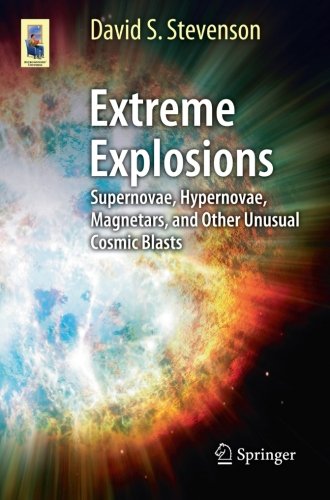
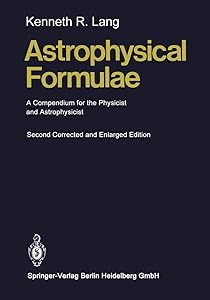
Extreme Explosions: Supernovae, Hypernovae, Magnetars, and Other Unusual Cosmic Blasts (Astronomers' Universe) by Kenneth R. Lang

Extreme Explosions: Supernovae, Hypernovae, Magnetars, and Other Unusual Cosmic Blasts (Astronomers' Universe)

Kenneth R. Lang
369 pages
Springer
Sep 2013
Paperback
Science WSBN
1
Readers
0
Reviews
0
Discussions
0
Quotes
Review From the reviews:“Stevenson … has authored a book on the deaths of stars that is unlike any other work on the subject. In a clear but very detailed manner, he discusses stellar evolution, placing particular emphasis on the many diverse and unusual ways that stars die. … Budding astrophysicists and professionals will find it educational and very thought provoking. … Summing Up: Highly recommended. All academic, general, and professional library collections.” (A. Spero, Choice, Vol. 51 (9), May, 2014) From the Author It was a real pleasure writing this book. It began life in 2003 as a much broader work on the lives of stars. I did have an (unsuccessful) pop at publishing this at the time. In the same year Popular Astronomy published an article I wrote for them on red dwarfs - which ultimately led to the sibling book, Under a Crimson Sun, which was published in the same year as Extreme Explosions. With evidence of astronomy writing, Sky and Telescope published two articles on supernovae in 2007 and 2011. It was these that led to the idea for a book on weird and wonderful supernovae. From the mid-2000s onwards, automated supernova searches were pouring out weird and wonderful explosions that I felt would lend them to a largely non-academic book. These new explosisons would take the reader beyond the heavily published, but nonetheless popular gamma ray bursts. I constructed the book around four key areas. The first is a general introduction to supernovae and the lives of the universe's most massive residents. From thereon I chose to introduce the most unusual core-collapse supernovae - those produced by these most massive residents. There was a lot here to go on - and that was interesting in itself. For as I was writing the book, more and more examples kept emerging, causing a rather scary expansion of the book - somewhat akin to the formation of the supergiants the book describes... This section was, in essence an extension of the 2011 article for Sky and Telescope article on pair instability supernovae and owes a lot to astrophysicists Nathan Smith and Robert Quimby. I was also very interested in the work of Japanese Astrophysicist Keni'ichi Nomoto, which often appeared at odds with prevailing theories. In that regard it was gratifying to see his ideas verified as I was writing. The third section examines Type Ia supernovae in their expanding repertoire of forms. This drew on the 2007 Sky and Telescope article, but once again featured a rapidly expanding population of explosions that were pouring out of automated supernova searches. I had to amend the book as it was going to press to accommodate the most recent discoveries from Ryan Foley. The final section, is probably the most personal. As well as considering eruptions (if not true explosions) caused by stellar mergers, it was a testing ground for introducing phylogeny to astronomy. Phylogeny is a biological term for classification and supernovae seemed an area ripe for its interrogation. I was very bemused when I stumbled across work from St Andrews University which had used this to classify stars using a computer program I was very familiar with. It was also an area where I returned to my favorite (maverick) Biologist, the late Professor Carl Woese. I had done a little work with Carl in 2000, while I was writing an article on evolution. Despite his formidable reputation, he was a highly personable individual who gave up some of his time to examine my crazy idea on the origin of a key process in Biology. Carl was instrumental in revolutionizing classification of bacteria and, without going into the details, his work suggested (to me) some interesting parallels with development in the field in Astronomy. I hope that my links to Biology are informative and hopefully inspire a bit of cross-curricular talk, which I always find healthy!
Join the conversation

No discussions yet. Join BookLovers to start a discussion about this book!

No reviews yet. Join BookLovers to write the first review!

No quotes shared yet. Join BookLovers to share your favorite quotes!

Earn Points
Your voice matters. Every comment, review, and quote earns you reward points redeemable for Bitcoin.
Comment +5 pts Review +20 pts Quote +7 pts Upvote +1 pt
BookMatch Quiz
Find books similar to this one
About this book
Pages 369
Publisher Springer
Published 2013
Readers 1