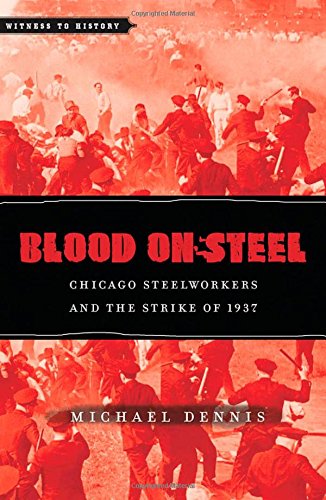


Blood on Steel: Chicago Steelworkers and the Strike of 1937 by Michael Dennis

Blood on Steel: Chicago Steelworkers and the Strike of 1937

Michael Dennis
140 pages
Johns Hopkins University Press
Jul 2014
Hardcover
Business & Investing WSBN
1
Readers
0
Reviews
0
Discussions
0
Quotes
<p>On Memorial Day 1937, thousands of steelworkers, middle-class supporters, and working-class activists gathered at Sam's Place on the Southeast Side of Chicago to protest Republic Steel's virulent opposition to union recognition and collective bargaining. By the end of the day, ten marchers had been mortally wounded and more than one hundred badly injured, victims of a terrifying police riot. Sam's Place, the headquarters for the steelworkers, was transformed into a bloody and frantic triage unit for treating heads split open by police batons, flesh torn by bullets, and limbs mangled badly enough to require amputation. </p><p>While no one doubts the importance of the Memorial Day Massacre, Michael Dennis identifies it as a focal point in the larger effort to revitalize American equality during the New Deal. In <i>Blood on Steel</i>, Dennis shows how the incident -- captured on film by Paramount newsreels -- validated the claims of labor activists and catalyzed public opinion in their favor. </p><p>In the aftermath of the massacre, Senate hearings laid bare patterns of anti-union aggression among management, ranging from blacklists to harassment and vigilante violence. Companies were determined to subvert the right to form a union, which Congress had finally recognized in 1935. Only in the following year would Congress pass the Fair Labor Standards Act, which established a minimum wage and a maximum work week, outlawed child labor, and regulated hazardous work. Like the Wagner Act that protected collective bargaining, this law aimed to protect workers who had suffered the worst of what the Great Depression had inflicted. </p><p>Dennis's wide-angle perspective reveals the Memorial Day Massacre as not simply another bloody incident in the long story of labor-management tension in American history but as an illustration of the broad-based movement for social democracy which developed in the New Deal era.</p>
Join the conversation

No discussions yet. Join BookLovers to start a discussion about this book!

No reviews yet. Join BookLovers to write the first review!

No quotes shared yet. Join BookLovers to share your favorite quotes!

Earn Points
Your voice matters. Every comment, review, and quote earns you reward points redeemable for Bitcoin.
Comment +5 pts Review +20 pts Quote +7 pts Upvote +1 pt
BookMatch Quiz
Find books similar to this one
About this book
Pages 140
Publisher Johns Hopkins Univer...
Published 2014
Readers 1