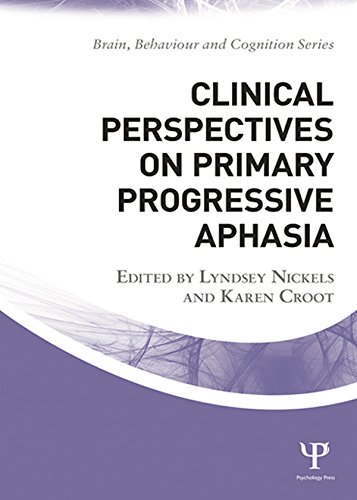
Clinical Perspectives on Primary Progressive Aphasia (Brain, Behaviour and Cognition) by Lyndsey Nickels

Clinical Perspectives on Primary Progressive Aphasia (Brain, Behaviour and Cognition)

Lyndsey Nickels
507 pages
Psychology Press
Oct 2017
Hardcover
Health, Mind & Body WSBN
0
Readers
0
Reviews
0
Discussions
0
Quotes
Primary progressive aphasia is a type of dementia that progressively impairs language abilities (speaking, understanding, reading and writing) and may eventually affect other aspects of thinking, movement and/or personality. For the person with primary progressive aphasia, these problems have a profound effect on their ability to communicate, which in turn impacts their relationships, social networks and ability to participate in everyday activities that depend on communication. Recent understanding of primary progressive aphasia has grown enormously, however, and this book provides an up-to-date survey of research relevant to the clinical care of people with primary progressive aphasia. It covers initial diagnosis, neuropathology, genetics and typical patterns of progression from early- to late-stage disease, with a special focus on management and intervention for a range of different language symptoms and everyday communication activities.This book is suitable for a wide readership, from neurologists, geriatricians and other medical specialists, to general practitioners, speech and language therapists, occupational therapists, psychologists and students in these fields. It was originally published as a special issue of the journal Aphasiology.
Join the conversation

No discussions yet. Join BookLovers to start a discussion about this book!

No reviews yet. Join BookLovers to write the first review!

No quotes shared yet. Join BookLovers to share your favorite quotes!

Earn Points
Your voice matters. Every comment, review, and quote earns you reward points redeemable for Bitcoin.
Comment +5 pts Review +20 pts Quote +7 pts Upvote +1 pt
BookMatch Quiz
Find books similar to this one
About this book
Pages 507
Publisher Psychology Press
Published 2017
Readers 0