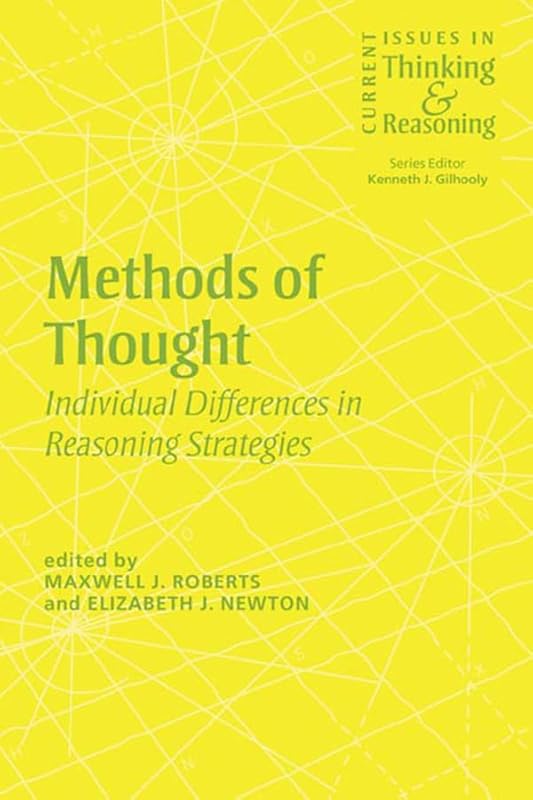
Methods of Thought: Individual Differences in Reasoning Strategies (Current Issues in Thinking and Reasoning) by Elizabeth Newton

Methods of Thought: Individual Differences in Reasoning Strategies (Current Issues in Thinking and Reasoning)

Elizabeth Newton
208 pages
Psychology Press
Jun 2004
Hardcover
Science WSBN
0
Readers
0
Reviews
0
Discussions
0
Quotes
How do people make inferences? How do their reasoning processes differ and why? Methods of Thought attempts to answer these questions by looking in detail at the different reasoning strategies people apply, how these are acquired, how they are selected and how use of these strategies is influenced by individual and task properties. Focusing on empirical data and research into deductive reasoning tasks, this book summarizes current trends in the field and helps us to understand how individual differences in reasoning impact on other studies of higher cognitive abilities in humans. . Contributors include researchers who have shown that people make deductions by using a variety of strategies, and others who have found that deductive reasoning problems provide a useful test-bed for investigating general theories of strategy development. Together, it is shown that these general theories derived from other domains have important implications for deductive reasoning, and also that findings by reasoning researchers have wider consequences for general theories of strategy development. This book will be of interest to anyone studying or working in the fields of reasoning, problem solving, and cognitive development, as well as cognitive science in general.
Join the conversation

No discussions yet. Join BookLovers to start a discussion about this book!

No reviews yet. Join BookLovers to write the first review!

No quotes shared yet. Join BookLovers to share your favorite quotes!

Earn Points
Your voice matters. Every comment, review, and quote earns you reward points redeemable for Bitcoin.
Comment +5 pts Review +20 pts Quote +7 pts Upvote +1 pt
BookMatch Quiz
Find books similar to this one
About this book
Pages 208
Publisher Psychology Press
Published 2004
Readers 0