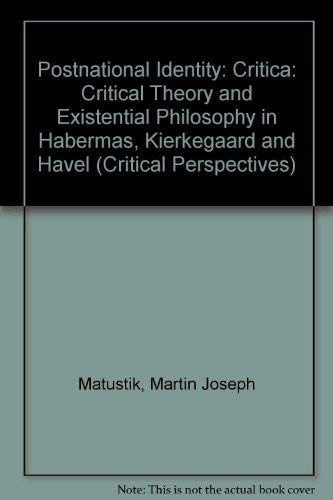
Postnational Identity: Critical Theory and Existential Philosophy in Habermas, Kierkegaard, and Havel
Martin J. Matustik
Contradictory interpretations have been applied to history-making events that led to the end of the cold Václav Havel, using Kierkegaardian terms, called the demise of totalitarianism in east-central Europe an "existential revolution"' (i.e. an awakening of human responsibility, spirit, and reason) , while others hailed it as a victory for the "New World Order." Regardless of one's point of view, however, it is clear that the global landscape has been dramatically altered. Where once the competition between capitalism and communism provided a basis for establishing political- and self-identity, today, the destructive forces of nationalist identity and religious and secular fundamentalism are filling the void.In his timely and significant new work, Martin J. Matu¿tík synthesizes the critical social theory of J rgen Habermas with the existentialism of Havel and Søren Kierkegaard to present an alternative to the conceptualization of identity based on nationalism that is stoking the flames of civil wars in Europe and racial and ethnic tensions in eastern Europe, the former Soviet Union, and the United States. In so doing, he reinvigorates critical social theory, and points the way toward a multicultural, post-national identity and a democracy capable of resisting both imperial consensus and xenophobic backlash.Offering the most extensive examination of Habermas's and Kierkegaard's critiques of nationalist identity available, Postnational Identity dramatically confronts the traditional view of existential philosophy as antisocial and uncritical. This volume shows how Kierkegaardian theory and practice of radically honest communication allows us to rethink the existential in terms of Habermas's communicative action, and vice versa. As the author explains the foundations of his work in theCritical theory and existential philosophy, brought together in this book, engender two forms of suspicion of the present age. The critical theorist, such as J rgen Habermas, unmasks the forms in which social and cultural life become systematically distorted by the imperatives of political power and economic gain. The existential critic, like Søren Kierkegaard and Václav Havel, is suspicious of the various ways in which individuals deceive themselves or other people. This study aims to integrate Kierkegaard's and Havel's existential critique of motives informing human identity formation with Habermas's critique of the colonialization of fragmented, anomic modern life by systems of power and money....My argument is that existential critique and social critique complement each other and overcome their respective limitations.Organized into three distinct sections, the book begins with a study of individual and group identity in Habermas's work on communicative ethics. This section draws on Habermas's readings of Kant, Hegel, Marx, Kierkegaard, Mead, and Durkheim. Part Two uses Kierkegaard's existential ethics to broaden Habermas's notion of identity. The argument proceeds from the performative character of existential individuality to Kierkegaard's theory and practice of communication, and, finally, to the regulative community ideal projected in his critique of the present age. In the book's final section, the author addresses the question of identity to the nationalist strife of the present age. Overall, the book sets forth the argument that a move from fundamentalist constructions of identity to postnational, open, and multicultural identity is a critical ideal on which both the existential and socio-political suspicion of the present age converge.Postnational Identity is addressed to the three multicultural audiences that gave it western Europe, eastern Europe, and the United States. One of the first works to treat seriously the existential thought of Václav Havel, the book will hold enormous appeal for students and professionals involved in existential philosophy, critical theory, philosophy, and, more generally, political science, literary theory, communications, and cultural studies.