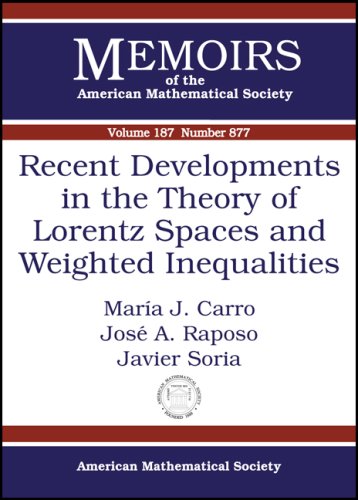
Recent Developments in the Theory of Lorentz Spaces and Weighted Inequalities (Memoirs of the American Mathematical Society) by Maria J. Carro

Recent Developments in the Theory of Lorentz Spaces and Weighted Inequalities (Memoirs of the American Mathematical Society)

Maria J. Carro
128 pages
Amer Mathematical Society
Jan 2007
Paperback
Science WSBN
0
Readers
0
Reviews
0
Discussions
0
Quotes

Free account. We’ll keep this book ready while you join.

Find a copy

Formats and availability vary by store. As an Amazon Associate I earn from qualifying purchases.

The main objective of this work is to bring together two well known and, a priori, unrelated theories dealing with weighted inequalities for the Hardy-Littlewood maximal operator $M$. For this, the authors consider the boundedness of $M$ in the weighted Lorentz space $Lambdap u(w) $. Two examples are historically relevant as a If $w=1$, this corresponds to the study of the boundedness of $M$ on $Lp(u) $, which was characterized by B. Muckenhoupt in 1972, and the solution is given by the so called $A p$ weights. The second case is when we take $u=1$. This is a more recent theory, and was completely solved by M.A. Arino and B. Muckenhoupt in 1991. It turns out that the boundedness of $M$ on $Lambdap(w) $ can be seen to be equivalent to the boundedness of the Hardy operator $A$ restricted to decreasing functions of $Lp(w) $, since the nonincreasing rearrangement of $Mf$ is pointwise equivalent to $Af*$. The class of weights satisfying this boundedness is known as $B p$. Even though the $A p$ and $B p$ classes enjoy some similar features, they come from very different theories, and so are the techniques used on each Calderon-Zygmund decompositions and covering lemmas for $A p$, rearrangement invariant properties and positive integral operators for $B p$. This work aims to give a unified version of these two theories. Contrary to what one could expect, the solution is not given in terms of the limiting cases above considered (i.e., $u=1$ and $w=1$) , but in a rather more complicated condition, which reflects the difficulty of estimating the distribution function of the Hardy-Littlewood maximal operator with respect to general measures.
Join the conversation

No discussions yet. Join BookLovers to start a discussion about this book!

No reviews yet. Join BookLovers to write the first review!

No quotes shared yet. Join BookLovers to share your favorite quotes!

Earn Points
Your voice matters. Every comment, review, and quote earns you reward points redeemable for Bitcoin.
Comment +5 pts Review +20 pts Quote +7 pts Upvote +1 pt
Similar Books
Find books similar to this one
About this book
Pages 128
Publisher Amer Mathematical So...
Published 2007
Readers 0