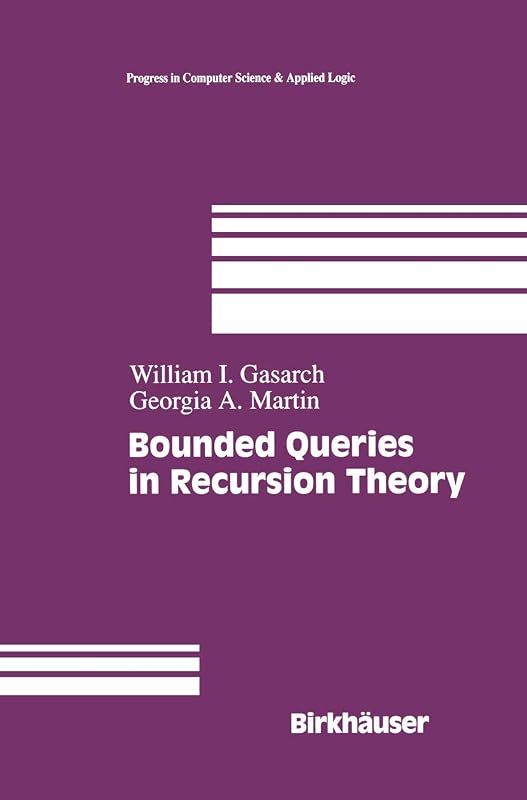
Bounded Queries in Recursion Theory (Progress in Computer Science and Applied Logic, 16) by William Levine

Bounded Queries in Recursion Theory (Progress in Computer Science and Applied Logic, 16)

William Levine
353 pages
Birkhäuser
Dec 1998
Hardcover
Computers & Internet WSBN
0
Readers
0
Reviews
0
Discussions
0
Quotes
One of the major concerns of theoretical computer science is the classifi­ cation of problems in terms of how hard they are. The natural measure of difficulty of a function is the amount of time needed to compute it (as a function of the length of the input) . Other resources, such as space, have also been considered. In recursion theory, by contrast, a function is considered to be easy to compute if there exists some algorithm that computes it. We wish to classify functions that are hard, i.e., not computable, in a quantitative way. We cannot use time or space, since the functions are not even computable. We cannot use Turing degree, since this notion is not quantitative. Hence we need a new notion of complexity-much like time or spac~that is quantitative and yet in some way captures the level of difficulty (such as the Turing degree) of a function. Read more Continue reading Read less REVIEW
"Ideal for an advanced undergraduate or beginning graduate student who has some exposure to basic computability theory and wants to see what one can do with it. The questions asked are interesting and can be easily understood and the proofs can be followed without a large amount of training in computability theory."

--Sigact News

Read more Continue reading Read less
Join the conversation

No discussions yet. Join BookLovers to start a discussion about this book!

No reviews yet. Join BookLovers to write the first review!

No quotes shared yet. Join BookLovers to share your favorite quotes!

Earn Points
Your voice matters. Every comment, review, and quote earns you reward points redeemable for Bitcoin.
Comment +5 pts Review +20 pts Quote +7 pts Upvote +1 pt
BookMatch Quiz
Find books similar to this one
About this book
Pages 353
Publisher Birkhäuser
Published 1998
Readers 0