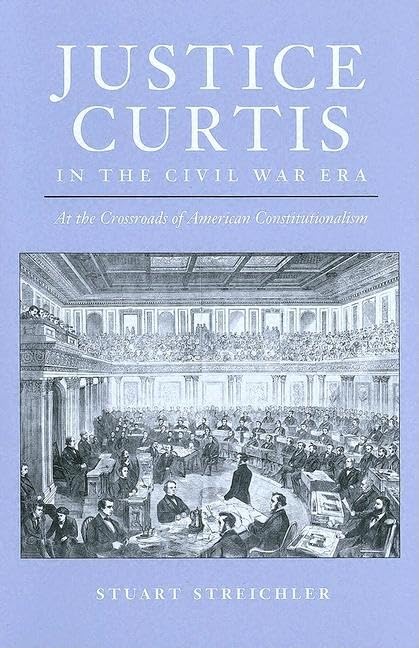
Justice Curtis in the Civil War Era: At the Crossroads of American Constitutionalism (Constitutionalism and Democracy) by Stuart Streichler

Justice Curtis in the Civil War Era: At the Crossroads of American Constitutionalism (Constitutionalism and Democracy)

Stuart Streichler
304 pages
University of Virginia Press
Jul 2005
Hardcover
Politics WSBN
0
Readers
0
Reviews
0
Discussions
0
Quotes

Free account. We’ll keep this book ready while you join.

Find a copy

Formats and availability vary by store. As an Amazon Associate I earn from qualifying purchases.

During a career as both a lawyer and a Supreme Court justice, Benjamin R. Curtis addressed practically every major constitutional question of the mid-nineteenth century, making judgments that still resonate in American law. Aside from a family memoir written by his brother over one hundred years ago, however, no book-length treatment of Curtis exists. Now Stuart Streichler has filled this gap in judicial biography, using Curtis's life and work as a window on the most serious constitutional crisis in American history, the Civil War.Curtis was the lead attorney for President Andrew Johnson in the Senate's impeachment trial, where he delivered the pivotal argument, and his was an influential voice in the pervasive constitutional struggle between states and the federal government. He is best remembered, however, for dissenting in the Dred Scott case, in which he disputed Chief Justice Taney's proslavery ruling that no black person could ever become a citizen of the United States. In the wake of the decision, Curtis resigned from the court, the only justice in the Supreme Court's history to do so on grounds of principle. Yet he also clashed with Boston's abolitionists over enforcing the Fugitive Slave Act, and he opposed the Emancipation Proclamation.In a period when the Constitution was radically transformed from a charter that protected slavery to one that granted all persons equal rights of citizenship, Justice Curtis maintained his faith in the Constitution as an adaptable instrument of self-government and tried to mark out a path for gradual change. Streichler assesses Curtis's common-law methods in the context of his divisive times and shows how the judge's views continue to shed light on issues that have become once again relevant, such as the presidential impeachment process and, after 9/11, the use of military tribunals to try civilians.
Join the conversation

No discussions yet. Join BookLovers to start a discussion about this book!

No reviews yet. Join BookLovers to write the first review!

No quotes shared yet. Join BookLovers to share your favorite quotes!

Earn Points
Your voice matters. Every comment, review, and quote earns you reward points redeemable for Bitcoin.
Comment +5 pts Review +20 pts Quote +7 pts Upvote +1 pt
Similar Books
Find books similar to this one
About this book
Pages 304
Publisher University of Virgin...
Published 2005
Readers 0