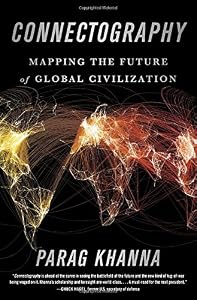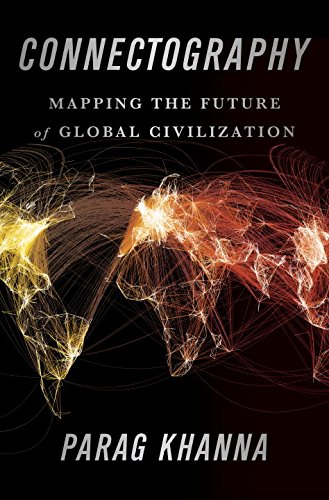
Connectography: Mapping the Future of Global Civilization by Parag Khanna
Connectography: Mapping the Future of Global Civilization

Parag Khanna
512 pages
Random House
Apr 2016
Business & Investing WSBN
4
Readers
1
Reviews
0
Discussions
0
Quotes
<b>From the visionary bestselling author of <i>The Second World </i>and<i> How to Run the World </i>comes a bracing and authoritative guide to a future shaped less by national borders than by global supply chains, a world in which the most connected powers - and people - will win.</b><br><br>Connectivity is the most revolutionary force of the twenty-first century. Mankind is reengineering the planet, investing up to ten trillion dollars per year in transportation, energy, and communications infrastructure linking the world's burgeoning mega-cities together. This has profound consequences for geopolitics, economics, demographics, the environment, and social identity. Connectivity, not geography, is our destiny.<br><br> In <i>Connectography, </i>visionary strategist Parag Khanna travels from Ukraine to Iran, Mongolia to North Korea, Pakistan to Nigeria, and across the Arctic Circle and the South China Sea to explain the rapid and unprecedented changes affecting every part of the planet. He shows how militaries are deployed to protect supply chains as much as borders, and how nations are less at war over territory than engaged in tugs-of-war over pipelines, railways, shipping lanes, and Internet cables. The new arms race is to connect to the most markets - a race China is now winning, having launched a wave of infrastructure investments to unite Eurasia around its new Silk Roads. The United States can only regain ground by fusing with its neighbors into a super-continental North American Union of shared resources and prosperity.<br><br> <i>Connectography</i> offers a unique and hopeful vision for the future. Khanna argues that new energy discoveries and technologies have eliminated the need for resource wars; ambitious transport corridors and power grids are unscrambling Africa's fraught colonial borders; even the Arab world is evolving a more peaceful map as it builds resource and trade routes across its war-torn landscape. At the same time, thriving hubs such as Singapore and Dubai are injecting dynamism into young and heavily populated regions, cyber-communities empower commerce across vast distances, and the world's ballooning financial assets are being wisely invested into building an inclusive global society. Beneath the chaos of a world that appears to be falling apart is a new foundation of connectivity pulling it together.<br><br><b>Advance praise for <i>Connectography</i></b><br><br> &quot;Ahead of the curve in seeing the battlefield of the future, and the new kind of tug-of-war being waged on it. Parag Khanna's scholarship and foresight are world-class. A must-read for the next president.&quot;<b> - Chuck Hagel, former U.S. secretary of defense</b><br><br> &quot;This bold reframing is an exciting addition to our ongoing debate about geopolitics and the future of globalization.&quot;<b> - Dominic Barton, global managing partner, McKinsey &amp; Company</b><br><br> &quot;Gives the reader an amazing new perspective on human society, bypassing the timeworn categories and frameworks we usually use. A must-read for anyone who wants to understand the future of humanity.&quot;<b> - Sandy Pentland, professor, MIT Media Lab</b><br><br> &quot;Reading <i>Connectography</i> is a real adventure. The expert knowledge of Khanna has produced a comprehensive and fascinating book anchored in geography but extending to every field that connects people around the globe.&quot;<b> - Mark Mobius, executive chairman, Templeton Emerging Markets Group</b><br><br> &quot;Khanna's latest book provides an invaluable guide to the volatile, confusing worlds of early twenty-first-century geopolitics.&quot;<b> - Neil Brenner, director, Urban Theory Lab, Harvard University Graduate School of Design</b>
Join the conversation

No discussions yet. Join BookLovers to start a discussion about this book!

Really Thought Provoking

It's one of the most interesting books I read in 2016. It changes your perspective on the world. I hadn't considered the extent of supply chains in terms if geopolitical power. The book The Colder War by Marin Katusa expans on the idea of economic warfare, but Connectography makes you reconsider your world view entirely. I didn't agree with every claim the author made. Ex: he claims that a complete freedom of product flows between nations would increase world GDP (thus advocating it) but this doesn't tell us if certain nations would lose from these reductions of trade barriers. If the flow of wealth would accelerate it's escape from West to East, why would the West accept this? He also advocates the elimination of boarders between countries and mass immigration. This was a major contradiction in his argument. While he claims China is winning the connection race through more integrated supply chains, it's a complete nightmare to try to get a Chinese citizenship even after you've married a Chinese! In China there is no contradiction in nationalism and supply chain connections, yet he claims the US and Europe should open their boarders and abandon their national identity for the sake of world economic gain (not necessarily the Wests gain it seems like). The book had a very utilitarian philosophy behind it, with no regard to cultural differences as markers of competitive advantages or disadvantages (Neil Fergusons book as simplified examples). He also claims that there should be a destruction of the nation state. The rise of national identeties around the world is one if the reasons for the collapse of European Empires exploiting their colonies. National identity is key to freedom. Despite major objections to some of the books conclusions I'm giving the book a five star. The author makes some very intelligent observations I've not read anywhere else. Besides, it's not my place to downgrade a review due to political difference despite the economic data showing that th...

No quotes shared yet. Join BookLovers to share your favorite quotes!

Earn Points
Your voice matters. Every comment, review, and quote earns you reward points redeemable for Bitcoin.
Comment +5 pts Review +20 pts Quote +7 pts Upvote +1 pt
BookMatch Quiz
Find books similar to this one
About this book
Pages 512
Publisher Random House
Published 2016
Readers 4