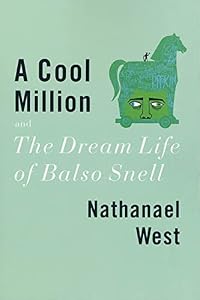
Miss Lonelyhearts is Nathanael West's second novel. It is an Expressionist black comedy set in New York City during the Great Depression.
In the story, Miss Lonelyhearts is an unnamed male newspaper columnist writing an advice column, which is viewed by the newspaper as a joke. As "Miss Lonelyhearts" reads letters from desperate New Yorkers, he feels terribly burdened and falls into a cycle of deep depression, accompanied by heavy drinking and occasional barfights. He also suffers from the pranks and cynical advice of his editor at the newspaper, named "Shrike", which is also a type of predatory bird. Miss Lonelyhearts tries several approaches as a way out of this depression (including religion, escaping to the countryside, and sex) but only ends up more confused.
The general theme of the novel is one of extreme disillusionment with Depression-era American society, a consistent theme throughout West's novels. However, the novel is essentially a black comedy and is characterized by an extremely dark but clever sense of humor and irony. The novel can be treated as a meditation on the theme of theodicy, or the problem of why evil exists in the world. The novel's protagonist is psychologically overwhelmed by his perception of this evil, which is treated as an explanation for his increasingly desperate psychological condition. Although the characters of Miss Lonelyhearts are grotesque caricatures, the periodic letters sent to Miss Lonelyhearts, which describe real people with real insoluble problems, serve to ground the novel's Expressionism in reality.
Read more REVIEW
"In dark times, Miss Lonelyhearts shines the brightest light in the blackest places. For this reason West's novel has never felt more alive than today."
-- Nathaniel Rich, The Daily Beast FROM THE INSIDE FLAP
"Somehow or other I seem to have slipped in between all the 'schools, '" observed Nathanael West the year before his untimely death in 1940. "My books meet no needs except my own, their circulation is practically private and I'm lucky to be published." Yet today, West is widely recognized as a prophetic writer whose dark and comic vision of
a society obsessed with mass-
produced fantasies foretold much
of what was to come in American life.
Miss Lonelyhearts (1933) , which West envisioned as "a novel in the form of a comic strip," tells of an advice-to-the-lovelorn columnist who becomes tragically embroiled in the desperate lives of his readers. The Day of the Locust (1939) is West's great dystopian Hollywood novel based on his experiences at the seedy fringes of the movie industry.
"The work of Nathanael West, savagely, comically, tragically original, has come into its own," said novelist and screenwriter Budd Schulberg. "A new public [has] discovered in the writings of West a brilliant reflection of its own sense of chaos and helplessness in a world running more to madness than to reason." FROM THE BACK COVER
"Somehow or other I seem to have slipped in between all the 'schools, '" observed Nathanael West the year before his untimely death in 1940. "My books meet no needs except my own, their circulation is practically private and I'm lucky to be published". Yet today, West is widely recognized as a prophetic writer whose dark and comic vision of a society obsessed with mass-produced fantasies foretold much of what was to come in American life. Miss Lonelyhearts (1933) , which West envisioned as "a novel in the form of a comic strip", tells of an advice-to-the-lovelorn columnist who becomes tragically embroiled in the desperate lives of his readers. The Day of the Locust (1939) is West's great dystopian Hollywood novel based on his experiences at the seedy fringes of the movie industry. ABOUT THE AUTHOR
In 1940, when an automobile accident prematurely claimed Nathanael West's life, he was a relatively obscure writer, the author of only four short novels. West's reputation has grown considerably since then and he is now considered one of the 20th century's major authors. Born in New York, West worked as the night manager of the Kenmore Hotel on East 23rd Street in Manhattan, as a contract scriptwriter for Columbia Pictures in Hollywood, and as a screenwriter for RKO Radio Picture.
Jonathan Lethem is the author of six novels, including the bestsellers The Fortress of Solitude and Motherless Brooklyn, which won the National Book Critics Circle Award. He lives in Brooklyn and Maine. Read more