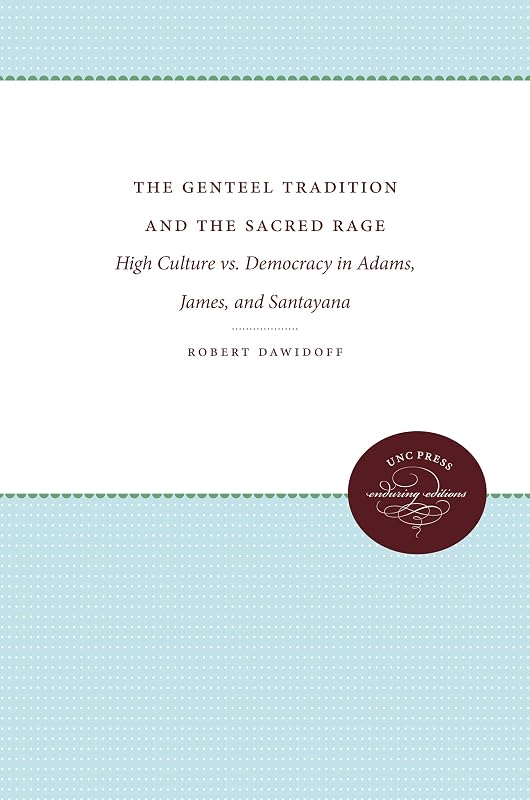
The Genteel Tradition and the Sacred Rage: High Culture vs. Democracy in Adams, James, and Santayana (Cultural Studies of the United States) by Robert Dawidoff

The Genteel Tradition and the Sacred Rage: High Culture vs. Democracy in Adams, James, and Santayana (Cultural Studies of the United States)

Robert Dawidoff
244 pages
The University of North Carolina Press
Sep 2010
Paperback
Politics WSBN
0
Readers
0
Reviews
0
Discussions
0
Quotes

Free account. We’ll keep this book ready while you join.

Find a copy

Formats and availability vary by store. As an Amazon Associate I earn from qualifying purchases.

Asking why many American intellectuals have had such difficulty accepting wholeheartedly the cultural dimensions of democracy, Robert Dawidoff examines their alienation and ambivalence, a tradition of detachment he identifies as "Tocquevillian." In the work of three towering American literary figures - Henry Adams, Henry James, and George Santayana -- Dawidoff explores fully this distancing and uneasy response to democratic culture.. Linked together by common Harvard, Cambridge, and New England connections, and by an upper-class, Brahmin background, each of these three writers, Dawidoff argues, was at once self-critical and contemptuous of cultural democracy -- especially its indifference to them and what they represented. But their claims to detached observation of democratic culture must be viewed skeptically, Dawidoff warns, and borrowed with caution.. An important contribution of the book is its integration of gay issues into American intellectual history. Viewing James's and Santayana's attitudes toward their homosexuality as affecting their views of American society, Dawidoff examines this significant and overlooked element in the American intellectual and cultural mix. Dawidoff also includes powerful new readings of Adams's Democracy and James's The Ambassadors and discusses Santayana's Americanist essays.. In his foreward, Alan Trachtenberg notes the "taboo" that seems to have fallen over the word democracy. "It is rarely encountered anymore in humanistic studies," he says, " snubbed in favor of gender, class, race, region." This trend, he says, may be in part due to an unease about studying the culture in which we participate because the posture of the cutural critic implies a certain detachment. "The Genteel Tradition and the Sacred Rage returns the question of democracy to centerstage," he concludes, "not as political theory alone but as cultural and personal experience.". Originally published in 1992.. A UNC Press Enduring Edition -- UNC Press Enduring Editions use the latest in digital technology to make available again books from our distinguished backlist that were previously out of print. These editions are published unaltered from the original, and are presented in affordable paperback formats, bringing readers both historical and cultural value.
Join the conversation

No discussions yet. Join BookLovers to start a discussion about this book!

No reviews yet. Join BookLovers to write the first review!

No quotes shared yet. Join BookLovers to share your favorite quotes!

Earn Points
Your voice matters. Every comment, review, and quote earns you reward points redeemable for Bitcoin.
Comment +5 pts Review +20 pts Quote +7 pts Upvote +1 pt
Similar Books
Find books similar to this one
About this book
Pages 244
Publisher The University of No...
Published 2010
Readers 0