
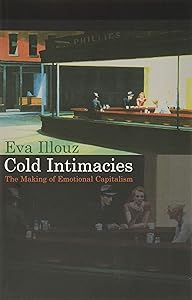
Why Love Hurts: A Sociological Explanation by Eva Illouz

Why Love Hurts: A Sociological Explanation

Eva Illouz
293 pages
Polity Press
Jun 2012
Hardcover
Self-Help WSBN
1
Readers
0
Reviews
0
Discussions
0
Quotes
Few of us have been spared the agonies of intimate relationships. They come in many shapes: loving a man or a woman who will not commit to us, being heartbroken when we're abandoned by a lover, engaging in Sisyphean internet searches, coming back lonely from bars, parties, or blind dates, feeling bored in a relationship that is so much less than we had envisaged - these are only some of the ways in which the search for love is a difficult and often painful experience. <p>Despite the widespread and almost collective character of these experiences, our culture insists they are the result of faulty or insufficiently mature psyches. For many, the Freudian idea that the family designs the pattern of an individual's erotic career has been the main explanation for why and how we fail to find or sustain love. Psychoanalysis and popular psychology have succeeded spectacularly in convincing us that individuals bear responsibility for the misery of their romantic and erotic lives. The purpose of this book is to change our way of thinking about what is wrong in modern relationships. The problem is not dysfunctional childhoods or insufficiently self-aware psyches, but rather the institutional forces shaping how we love.</p> <p>The argument of this book is that the modern romantic experience is shaped by a fundamental transformation in the ecology and architecture of romantic choice. The samples from which men and women choose a partner, the modes of evaluating prospective partners, the very importance of choice and autonomy and what people imagine to be the spectrum of their choices: all these aspects of choice have transformed the very core of the will, how we want a partner, the sense of worth bestowed by relationships, and the organization of desire.</p> <p>This book does to love what Marx did to commodities: it shows that it is shaped by social relations and institutions and that it circulates in a marketplace of unequal actors.</p>
Join the conversation

No discussions yet. Join BookLovers to start a discussion about this book!

No reviews yet. Join BookLovers to write the first review!

No quotes shared yet. Join BookLovers to share your favorite quotes!

Earn Points
Your voice matters. Every comment, review, and quote earns you reward points redeemable for Bitcoin.
Comment +5 pts Review +20 pts Quote +7 pts Upvote +1 pt
BookMatch Quiz
Find books similar to this one
About this book
Pages 293
Publisher Polity Press
Published 2012
Readers 1