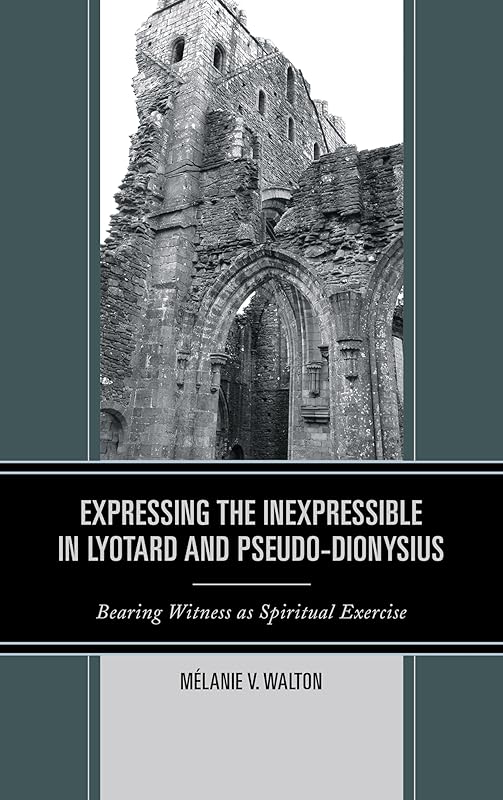
Expressing the Inexpressible in Lyotard and Pseudo-Dionysius: Bearing Witness as Spiritual Exercise by Mélanie V. Walton

Expressing the Inexpressible in Lyotard and Pseudo-Dionysius: Bearing Witness as Spiritual Exercise

Mélanie V. Walton
326 pages
Lexington Books
Aug 2013
Hardcover
Psychology & Philosophy WSBN
0
Readers
0
Reviews
0
Discussions
0
Quotes
Testimony demands the witness to demonstrate her knowledge - that knowledge that she must have by the fact of being a witness to something, even if this something exceeds the possibility of expression by any means amenable to verification. Expressing the Inexpressible in Lyotard and Pseudo-Dionysius: Bearing Witness as Spiritual Exercise rigorously studies the inexpressible expression provoked by two illustrative examples: the silenced testimony of the Holocaust survivor, in Jean-François Lyotard's The Differend, and the religious faithful, in Pseudo-Dionysius' The Divine Names. Though coming from vastly different philosophical moments, the methods used by Lyotard and Dionysius prove to dissolve the apparent heterogeneity of postmodernism and Neoplatonist Christian mysticism and open radical new lines of dialogue. Mélanie Victoria Walton critically evaluates each thinker and tradition, rethinks witnessing, testimony, sublimity, and apophaticism, and then engages them together to forge a new reading of silence and eros. The resulting insights will be especially valuable to students and scholars of Continental philosophy, philosophy of religion, theology and religious studies, medieval studies, and Holocaust studies. Read more Continue reading Read less REVIEW
"Mélanie V. Walton explains why the paradoxical search to do justice to the inexpressible is central to Lyotard's later work. This demonstration places him at the heart of contemporary discussions in ethics and law about justice for those who cannot speak of the harm done to them. She does so on the basis of thorough and original research, with the added brilliant flourish of situating the debate in relation to Neoplatonism and the problems of knowledge of God." -- James Williams, University of Dundee

"Mélanie Walton's study goes beyond explaining the nature of a differend, where one idiom finds no access possible to the dominant genres without losing voice, validity, or persuasiveness. Walton moves sedulously through the context and argumentation of Lyotard's 'magnus opus'monument to the task of bearing witness to the inexpressible, into a study of the mystic who developed a negative semantics, an apophatics of 'God.' Her exploration of Pseudo-Dionysus reveals his method of naming as an impossible enterprise through which God is 'named' all that we could know and yet cannot know of the divinity." -- Bettina Bergo, Professor of Philosophy, University of Montreal ABOUT THE AUTHOR
Mélanie Victoria Walton is assistant professor of philosophy at Belmont University.
Read more Continue reading Read less
Join the conversation

No discussions yet. Join BookLovers to start a discussion about this book!

No reviews yet. Join BookLovers to write the first review!

No quotes shared yet. Join BookLovers to share your favorite quotes!

Earn Points
Your voice matters. Every comment, review, and quote earns you reward points redeemable for Bitcoin.
Comment +5 pts Review +20 pts Quote +7 pts Upvote +1 pt
BookMatch Quiz
Find books similar to this one
About this book
Pages 326
Publisher Lexington Books
Published 2013
Readers 0