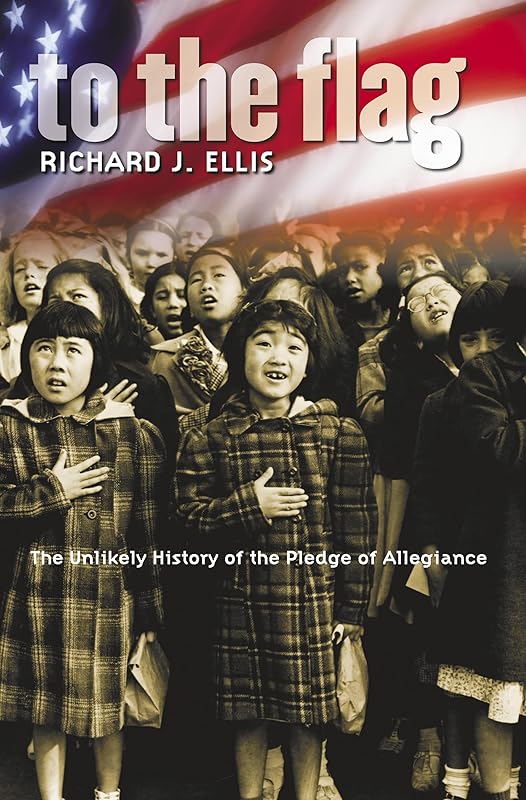
To the Flag: The Unlikely History of the Pledge of Allegiance by Richard J. Ellis

To the Flag: The Unlikely History of the Pledge of Allegiance

Richard J. Ellis
318 pages
University Press of Kansas
Apr 2005
Paperback
Politics WSBN
0
Readers
0
Reviews
0
Discussions
0
Quotes
For over one hundred years, it has been deeply ingrained in American culture. Saluting the flag in public schools began as part of a national effort to Americanize immigrants, its final six words imbuing it with universal hope and breathtaking power. Now Richard Ellis unfurls the fascinating history of the Pledge of Allegiance and of the debates and controversies that have sometimes surrounded it. . For anyone who has ever recited those thirty-one words, To the Flag provides an unprecedented historical perspective on recent challenges to the Pledge. As engaging as it is informative, it traces the story from the Pledge's composition by Francis Bellamy in 1892 up to the Supreme Court's action in 2004 regarding atheist Michael Newdow's objection to the words "under God." Ellis is especially good at highlighting aspects of this story that might not be familiar to most readers: the schoolhouse flag movement, the codification of the Pledge at the First National Flag Conference in 1923, changing styles of salute, and the uses of the Pledge to quell public concerns over sundry strains of radicalism. . Created against the backdrop of rapid immigration, the Pledge has continued for over a century to be injected into American politics at times of heightened anxiety over the meaning of our national identity. Ellis analyzes the text of the Pledge to tell how the very words "indivisible" and "allegiance" were intended to invoke Civil War sentiments-and how "with liberty and justice for all" forms a capsule expression of the American creed. He also examines the introduction of "under God" as an anti-Communist declaration in the 1950s, demonstrating that the phrase is not mere ceremonial Deism but rather a profound expression of what has been called America's "civil religion." . The Pledge has inspired millions but has also been used to promote conformity and silence dissent-indeed its daily recitation in schools and legislatures tells us as much about our anxieties as a nation as it does about our highest ideals. Ellis reveals how, for over a century, those who have been most fearful about threats to our national identity have often been most insistent on the importance of patriotic rituals. Indeed, by addressing this inescapable paradox of our civic life, Ellis opens a new and unexpected window on the American soul.
Join the conversation

No discussions yet. Join BookLovers to start a discussion about this book!

No reviews yet. Join BookLovers to write the first review!

No quotes shared yet. Join BookLovers to share your favorite quotes!

Earn Points
Your voice matters. Every comment, review, and quote earns you reward points redeemable for Bitcoin.
Comment +5 pts Review +20 pts Quote +7 pts Upvote +1 pt
BookMatch Quiz
Find books similar to this one
About this book
Pages 318
Publisher University Press of...
Published 2005
Readers 0