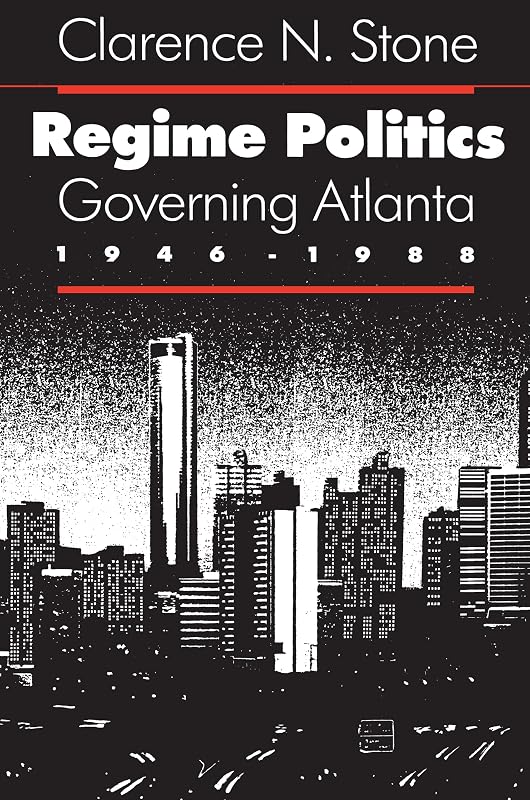

Regime Politics: Governing Atlanta, 1946-1988 by Clarence N. Stone

Regime Politics: Governing Atlanta, 1946-1988

Clarence N. Stone
328 pages
University Press of Kansas
Sep 1989
Paperback
Politics WSBN
0
Readers
0
Reviews
0
Discussions
0
Quotes
From the end of Georgia's white primary in 1946 to the present, Atlanta has been a community of growing black electoral strength and stable white economic power. Yet the ballot box and investment money never became opposing weapons in a battle for domination. Instead, Atlanta experienced the emergence and evolution of a biracial coalition. Although beset by changing conditions and significant cost pressures, this coalition has remained intact. At critical junctures forces of cooperation overcame antagonisms of race and ideology.. While retaining a critical distance from rational choice theory, author Clarence Stone finds the problem of collective action to be centrally important. The urban condition in America is one of weak and diffuse authority, and this situation favors any group that can act cohesively and control a substantial body of resources. Those endowed with a capacity to promote cooperation can attract allies and overcome oppositional forces.. On the negative side of the political ledger, Atlanta's style of civic cooperation is achieved at a cost. Despite an ambitious program of physical redevelopment, the city is second only to Newark, New Jersey, in the poverty rate. Social problems, conflict of interest issues, and inattention to the production potential of a large lower class bespeak a regime unable to address a wide range of human needs. No simple matter of elite domination, it is a matter of governing arrangements built out of selective incentives and inside deal-making; such arrangements can serve only limited purposes. The capacity of urban regimes to bring about elaborate forms of physical redevelopment should not blind us to their incapacity to address deeply rooted social problems.. Stone takes the historical approach seriously. The flow of events enables us to see how some groups deploy their resource advantages to fashion governing arrangements to their liking. But no one enjoys a completely free hand; some arrangements are more workable than others. Stone's theory-minded analysis of key events enables us to ask why and what else might be done. Regime Politics offers readers a political history of postwar Atlanta and an elegant, innovative, and incisive conceptual framework destined to influence the way urban politics is studied.
Join the conversation

No discussions yet. Join BookLovers to start a discussion about this book!

No reviews yet. Join BookLovers to write the first review!

No quotes shared yet. Join BookLovers to share your favorite quotes!

Earn Points
Your voice matters. Every comment, review, and quote earns you reward points redeemable for Bitcoin.
Comment +5 pts Review +20 pts Quote +7 pts Upvote +1 pt
BookMatch Quiz
Find books similar to this one
About this book
Pages 328
Publisher University Press of...
Published 1989
Readers 0