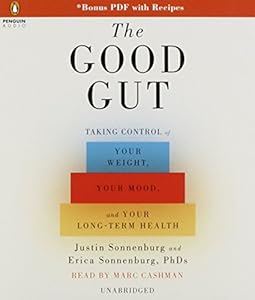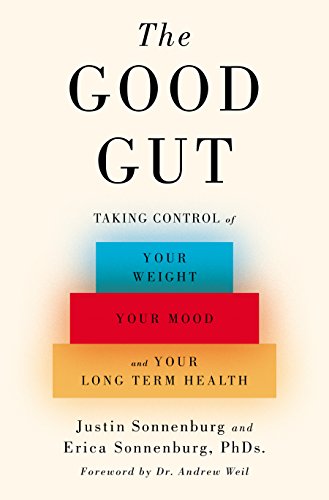
The Good Gut: Taking Control of Your Weight, Your Mood, and Your Long-term Health by Erica Sonnenburg

The Good Gut: Taking Control of Your Weight, Your Mood, and Your Long-term Health

Erica Sonnenburg
302 pages
Penguin Press
Apr 2015
Science WSBN
4
Readers
1
Reviews
0
Discussions
0
Quotes
<p><b>The groundbreaking science behind the surprising source of good health</b><br><br> Stanford University's Justin and Erica Sonnenburg are pioneers in the most exciting and potentially transformative field in the entire realm of human health and wellness, the study of the relationship between our bodies and the trillions of organisms representing thousands of species to which our bodies play host, the microbes that we collectively call the microbiota. The microbiota interacts with our bodies in a number of powerful ways; the Sonnenburgs argue that it determines in no small part whether we're sick or healthy, fit or obese, sunny or moody. The microbiota has always been with us, and in fact has coevolved with humans, entwining its functions with ours so deeply, the Sonnenburgs show us, humans are really composite organisms having both microbial and human parts. But now, they argue, because of changes to diet, antibiotic over-use, and over-sterilization, our gut microbiota is facing a &quot;mass extinction event,&quot; which is causing our bodies to go haywire, and may be behind the mysterious spike in some of our most troubling modern afflictions, from food allergies to autism, cancer to depression. It doesn't have to be this way.<br> <i><br>The Good Gut</i> offers a new plan for health that focuses on how to nourish your microbiota, including recipes and a menu plan. In this groundbreaking work, the Sonnenburgs show how we can keep our microbiota off the endangered species list and how we can strengthen the community that inhabits our gut and thereby improve our own health. The answer is unique for each of us, and it changes as you age. <br><br> In this important and timely investigation, the Sonnenburgs look at safe alternatives to antibiotics; dietary and lifestyle choices to encourage microbial health; the management of the aging microbiota; and the nourishment of your own individual microbiome.<br><br> Caring for our gut microbes may be the most important health choice we can make.</p><br><br><br><i>From the Hardcover edition.</i>
Join the conversation

No discussions yet. Join BookLovers to start a discussion about this book!

A book rich in important health information, advises, and warnings.

It’s a very important book in which we for example realize how the Western food is destroying our health, especially because we there are having an unbalance with too little, if any, fruit and vegetables against the meat, whereby our good bacteria not are getting their needed nutrients for working. And in the book, it for example also is thoughtful to learn how we later in life will be influenced by how we were brought to world, that is by either the natural way or born at Caesarean section, because it makes difference in which bacteria the newborn’s gut then contains. Because as we read, the child that passes through the birth canal as the first bacteria in life are getting those from the inside of the mother, while the C-section born babies first meets bacteria from outside the mother, from the skin. And where researches now have discovered that there is a connection between the C-section babies and obesity, allergy, asthma, and more. And then in the book we read about how a doctor worked on solving this problem, which was for his coming baby which would come to world as a C-section baby, still would be getting precisely the same bacteria’s as if born the natural way. Parallel to this case we see that we are having something to think about in the future. One of the other new, or rediscovered, very important science knowledges to read about in the book, is the fecal microbiota transplant (FMT), stood transplant, bacteriotherapy. And this was stated in 2013 in Amsterdam on participants on whom the antibiotic therapy had been unsuccessful, and then on half of the patients was used FMT, and for the other half again antibiotic. By the FMT method 81% of the patients was cured, while only 31% by antibiotic. Then it was decided to for a second-time use FMT on this rest on 19 % of the patients who not was cured by the first time. And then this time 94% was cured, so totally for the patients on the FMT research 98% - 99% were cured. And then it was decided to stop the re...

No quotes shared yet. Join BookLovers to share your favorite quotes!

Earn Points
Your voice matters. Every comment, review, and quote earns you reward points redeemable for Bitcoin.
Comment +5 pts Review +20 pts Quote +7 pts Upvote +1 pt
BookMatch Quiz
Find books similar to this one
About this book
Pages 302
Publisher Penguin Press
Published 2015
Readers 4