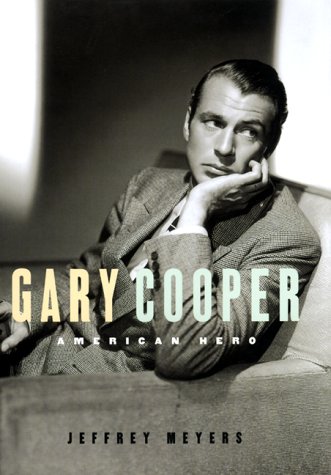
From Publishers Weekly On screen, Cooper (1901-1961) was the tall, lean AmericanAcowboy, soldier, baseball playerAwho embodied the ideals of duty, honor and integrity in a beguiling natural acting style. Off screen, he was the tall, lean American whose hedonism conflicted with the types of heroic roles that made him famous, most notably Longfellow Deeds in Mr. Deeds Goes to Town (1936) and Marshall Will Kane in High Noon (1952), for which he won his second Oscar (the first came in 1942 for Sgt. York). In this diligent biography, Meyers (Bogart: A Life in Hollywood) relies heavily on abridging Cooper's films and drawing analogies to his life. (He finds that Love in the Afternoon [1957] "reflected Cooper's relations with his mistresses," for example.) Cooper turned his personal charm, "ravishing androgyny" and riding skills into a film career that spanned more than 30 years, from 1925 to his death. The democratic hero of the movies had a British education; voted Republican; was a "friendly" witness before the House Un-American Activities Committee (though he never named names); and loved the trappings of wealth. But until mid-career, Meyer notes, Cooper was more famous for his tempestuous affairs with stars like Lupe Velez, Marlene Dietrich, Grace Kelly and Patricia Neal for than his acting ability. While Meyers ably assembles these aspects of Cooper's character, his account of the Montana-born icon never quite gets up to a full gallop. 16 pages of b&w photo insert not seen by PW. Reader's Digest book condensation. Copyright 1998 Reed Business Information, Inc. From Library Journal Actor Gary Cooper was a dichotomy. He was born and educated in England, yet he was the quintessential screen cowboy, the square-jawed honest symbol of the American West. He usually played laconic, "aw shucks, ma'am" characters, yet he was a sophisticated world traveler and man about town. He was politically conservative and a man's man (Hemingway's best friend), yet he loved women and his love life was tempestuous. This well-researched biography chronicles Cooper's life from his childhood growing up on a ranch in Montana to his stardom during Hollywood's golden age. Meyers (Bogart: A Life in Hollywood, LJ 12/96) had the cooperation of Cooper's daughter as well as his friends, and what emerges is a balanced portrait of the man and his films. Each film is carefully discussed, as is his personal life. Meyers includes extensive notes, a lengthy bibliography and a filmography in which he rates Cooper's films. An outstanding biography of a film icon, who, alas, has probably already been forgotten by today's generation.?Rosellen Brewer, Monterey Bay Area Cooperative Lib. System, CACopyright 1998 Reed Business Information, Inc.