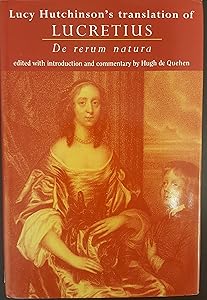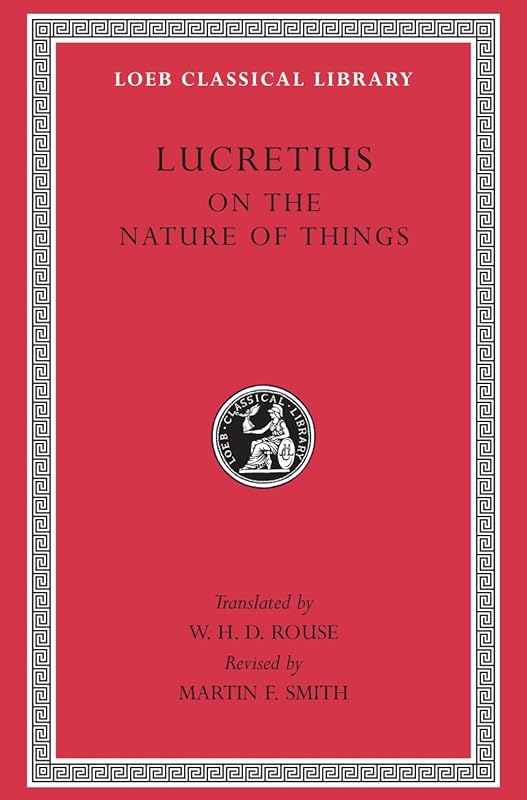

On the Nature of Things by Titus Lucretius Carus

On the Nature of Things

Titus Lucretius Carus
672 pages
Harvard University Press
Jan 1924
Hardcover
All Non-Fiction WSBN
2
Readers
0
Reviews
3
Discussions
0
Quotes
Atomic atheism in verse. Lucretius (Titus Lucretius Carus) lived ca. 99-ca. 55 BC, but the details of his career are unknown. He is the author of the great didactic poem in hexameters, De Rerum Natura (On the Nature of Things) . In six books compounded of solid reasoning, brilliant imagination, and noble poetry, he expounds the scientific theories of the Greek philosopher Epicurus, with the aim of dispelling fear of the gods and fear of death and so enabling man to attain peace of mind and happiness. In Book 1 he establishes the general principles of the atomic system, refutes the views of rival physicists, and proves the infinity of the universe and of its two ultimate constituents, matter and void. In Book 2 he explains atomic movement, the variety of atomic shapes, and argues that the atoms lack color, sensation, and other secondary qualities. In Book 3 he expounds the nature and composition of mind and spirit, proves their mortality, and argues that there is nothing to fear in death. Book 4 explains the nature of sensation and thought, and ends with an impressive account of sexual love. Book 5 describes the nature and formation of our world, astronomical phenomena, the beginnings of life on earth, and the development of civilization. In Book 6 the poet explains various atmospheric and terrestrial phenomena, including thunder, lightning, earthquakes, volcanoes, the magnet, and plagues. The work is distinguished by the fervor and poetry of the author.
Join the conversation
Lennart Lopin
Lennart Lopin
2 years ago

Currently reading “The Swerve” which makes me appreciate de rerum natura even more!

Lennart Lopin
Lennart Lopin
2 years ago

Gemini just said: “Lucretius' philosophical poem tackles big questions with poetic flair. Blending Epicurean ideas with stunning imagery, it explores atoms, the universe, mortality, and happiness. While its science holds historical significance, parts may feel outdated. Still, its challenge to dogma and focus on living well resonate with many. Whether you agree with it, its influence on philosophy and literature is undeniable. Check it out and see what you think! This summary is short, impactful, and mentions key points like philosophy, poetry, Epicureanism, science, and its lasting impact. Feel free to modify it further to fit your specific posting platform and audience.”

Lennart Lopin
Lennart Lopin
2 years ago

And this is what GPT4Turbo had to say: “Lucretius' "On the Nature of Things" is a masterpiece that interweaves ancient wisdom with the poetic elegance of the Epicurean tradition. This work delves into the fabric of existence, employing the concept of atoms to dissect the cosmos, life, and the human condition. It stands as a testament to the pursuit of knowledge and the importance of understanding the world around us. Despite some of its scientific perspectives being surpassed by modern discoveries, the poem's core message—encouraging critical thinking, challenging societal norms, and advocating for a life of tranquility and pleasure—remains profoundly relevant. It's not just a relic of philosophical thought but a beacon for those navigating the complexities of life and seeking solace in reason and nature. Engaging with Lucretius offers a unique lens through which we can contemplate our place in the universe and the pursuit of happiness, making it an essential exploration for anyone int

No reviews yet. Join BookLovers to write the first review!

No quotes shared yet. Join BookLovers to share your favorite quotes!

Earn Points
Your voice matters. Every comment, review, and quote earns you reward points redeemable for Bitcoin.
Comment +5 pts Review +20 pts Quote +7 pts Upvote +1 pt
BookMatch Quiz
Find books similar to this one
About this book
Pages 672
Publisher Harvard University P...
Published 1924
Readers 2