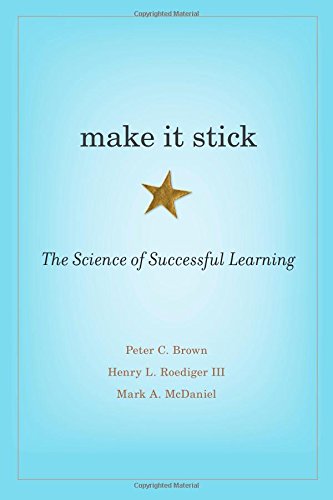
Make It Stick: The Science of Successful Learning by Peter C. Brown

Make It Stick: The Science of Successful Learning

Peter C. Brown
Belknap Press
Apr 2014
Hardcover
WSBN
3
Readers
1
Reviews
0
Discussions
0
Quotes
To most of us, learning something "the hard way" implies wasted time and effort. Good teaching, we believe, should be creatively tailored to the different learning styles of students and should use strategies that make learning easier. Make It Stick turns fashionable ideas like these on their head. Drawing on recent discoveries in cognitive psychology and other disciplines, the authors offer concrete techniques for becoming more productive learners. Memory plays a central role in our ability to carry out complex cognitive tasks, such as applying knowledge to problems never before encountered and drawing inferences from facts already known. New insights into how memory is encoded, consolidated, and later retrieved have led to a better understanding of how we learn.
Join the conversation

No discussions yet. Join BookLovers to start a discussion about this book!

Finally a learning book based on science!

Summary of the key concepts in the book: Conventional Wisdom: Make learning easy Best practice: Design learning with desirable difficulties Discussion: “Learning is deeper and more durable when it is effortful.” “Difficulties that elicit more effort and that slow down learning… will more than compensate for their inconvenience by making the learning stronger, more precise, and more enduring. Short-term impediments that make for stronger learning have come to be called desirable difficulties.” “Don’t assume you are doing something wrong if the learning feels hard.” “Not all difficulties in learning are desirable ones. Anxiety while taking a test seems to represent an undesirable difficulty.” Slow down to find meaning. Always read prior to the lecture. “Training has to be engaging in order to hold employees’ attention.” Conventional Wisdom: Concentrate on one topic at a time (aka. massed practice) Best practice: Interleave different but related topics Discussion: “Learning from interleaved practice feels slower than learning from massed practice.” While interleaving can impede performance during initial learning (tests taken immediately after exposure), interleaving has been show to boost “final test performance by a remarkable 215 percent.” In addition, “commonalities… learned through massed practice proved less useful than the differences … learned through interleaving.” “In interleaving, you don’t move from a complete practice set of one topic to go to another. You switch before each practice is complete… You need to shuffle your flashcards.” Conventional Wisdom: Reread material multiple times and in close succession Best practice: Space repetition Discussion: “Repetition by itself does not lead to good long-term memory… It makes sense to reread a text once if there’s been a meaningful lapse [at least a day in between] since the first reading.” “The increased effort required to retrieve the learning after a little forgetting has the effect of retriggering consol...

No quotes shared yet. Join BookLovers to share your favorite quotes!

Earn Points
Your voice matters. Every comment, review, and quote earns you reward points redeemable for Bitcoin.
Comment +5 pts Review +20 pts Quote +7 pts Upvote +1 pt
BookMatch Quiz
Find books similar to this one
About this book
Publisher Belknap Press
Published 2014
Readers 3