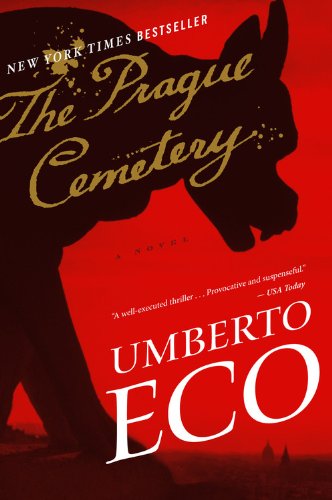

The Prague Cemetery by Umberto Eco

The Prague Cemetery

Umberto Eco
444 pages
Houghton Mifflin Harcourt
Sep 2012
Literature & Fiction WSBN
3
Readers
1
Reviews
0
Discussions
0
Quotes
<b>The #1 international bestseller, from Umberto Eco, author of <i>The Name of the Rose</i></b><br><br>&quot;Vintage Eco . . . the book is a triumph.&quot; - <i>New York Review of Books</i><br><br>Nineteenth-century Europe - from Turin to Prague to Paris - abounds with the ghastly and the mysterious. Jesuits plot against Freemasons. Italian republicans strangle priests with their own intestines. French criminals plan bombings by day and celebrate Black Masses at night. Every nation has its own secret service, perpetrating forgeries, plots, and massacres. Conspiracies rule history. From the unification of Italy to the Paris Commune to the Dreyfus Affair to The Protocols of the Elders of Zion, Europe is in tumult and everyone needs a scapegoat. But what if, behind all of these conspiracies, both real and imagined, lay one lone man?<br><br>&quot;[Eco] demonstrates once again that his is a voice that compels our attention&quot; - <i>San Francisco Chronicle</i><br><br>&quot;Choreographed by a truth that is itself so strange a novelist need hardly expand on it to produce a wondrous tale . . . Eco is to be applauded for bringing this stranger-than-fiction truth vividly to life.&quot; - <i>New York Times</i><br><br>&quot;Classic Eco, with a difference.&quot; - <i>Los Angeles Times</i><br><br>
Join the conversation

No discussions yet. Join BookLovers to start a discussion about this book!

The Power of Information, Espionage, Counterespionage & Manipulation

This book is about the power of information. It's about the people who fabricate it for others with hidden agendas. It's about the results of that information on its victims, the public, and rival countries. In essence, a propaganda war took place in view of the French and Italian public, who had no idea the real purpose behind the exciting events and headlines that were staged like theater. It later had a devastating result in other countries on a people who were truly innocent. The results included bombings, riots, murders and mayhem. Most tragically, attempted genocide... That is an example of the power of information. Obviously, there is much more to it than that, but let us go on... If we expand the operating theater to countries, we have governments with spy services, secret societies, powerful religious organizations, which are like countries and secret societies in one, AND you control central sources of information, it's called Propaganda. It is also POWER. If you play this game, you have to be very careful. Not only do you have enemies from other countries, but from religious sects, secret societies and double agents. If you are very lucky, you disappear to a foreign country, under an assumed named without your family, but you do get a pension from the service. If you were unlucky, and many were, days of torture followed by a longed for death was a common end. The stakes were high, but so was the pay and the rush. Our story takes place in the late 19th Century. The industrial revolution is taking off. Technology is about to blow the roof off the world, and few have any clue what's coming. Democracy worked in the states, even though we are considered upstarts on the Continent. Europe is writhing. Democracy failed in France thanks to Napolean, though they get a second chance after his heirs are ousted. Italy went to war for democracy with Garibaldi, and lost, so hatred of state and altar festered. The main reason for the turbulence, other than historical ...

No quotes shared yet. Join BookLovers to share your favorite quotes!

Earn Points
Your voice matters. Every comment, review, and quote earns you reward points redeemable for Bitcoin.
Comment +5 pts Review +20 pts Quote +7 pts Upvote +1 pt
BookMatch Quiz
Find books similar to this one
About this book
Pages 444
Publisher Houghton Mifflin Har...
Published 2012
Readers 3