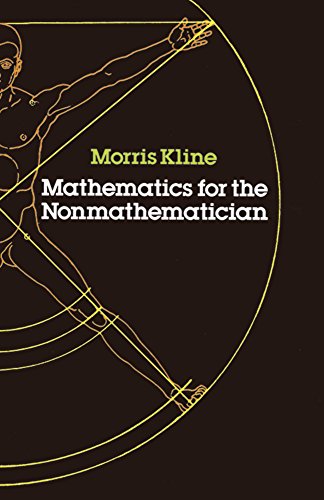
Mathematics for the Nonmathematician by Morris Kline

Mathematics for the Nonmathematician

Morris Kline
672 pages
Dover Publications
Jan 1971
Science WSBN
3
Readers
1
Reviews
0
Discussions
0
Quotes
Join the conversation

No discussions yet. Join BookLovers to start a discussion about this book!

As a certified nonmathematician, I pronounce this book excellent!

For a long time, I've been searching for a book exactly like this one. Somewhat embarrassed by my ignorance of math, I wanted to relearn what I had forgotten in college, and perhaps go further. But I didn't want to simply learn math; I wanted to learn its history, how it shaped and was shaped by the cultures in which it grew. This is a tall order, requiring both historical and mathematical understanding; but Kline is equal (or, perhaps, almost equal) to the task. Before I get into the positive qualities of this book, I should note its flaws. As another reviewer pointed out, Kline's beginning chapter on history is inept, even offensive. He heaps praise upon praise when describing the accomplishments of the Greeks, and dismisses the contributions of the Arabs, Babylonians, Egyptians, and Indians with a wave of the hand. He even relays the story of the Arabs destroying the library, which historians have seen fit to doubt as far back as Edward Gibbon. For Kline, mathematics made a brilliant beginning with the Greeks, and then stayed more or less the same until the Enlightenment. The extent to which that is true, I know not; but it at least seems unlikely to me. Thankfully, the book gets markedly better after that. (One shouldn't judge a book by the cover, or even the first chapter, apparently.) For, whatever Kline lacks as a historian, he makes up as a pedagogue. Kline doesn't simply move from arithmetic to geometry to algebra to trigonometry, but instead situates every subject within a specific historical period and practical problem. For example, he teaches trigonometry by using the kind of problems that the Alexandrian Greeks, such as Ptolemy and Eratosthenes, were tackling: the distance from the earth to the moon, the radius of the earth, the establishment of longitude and latitude. Every chapter comes with biographical sketches of the major thinkers involves, as well as some practical problem that the mathematical theory would solve. Following this procedure, Kl...

No quotes shared yet. Join BookLovers to share your favorite quotes!

Earn Points
Your voice matters. Every comment, review, and quote earns you reward points redeemable for Bitcoin.
Comment +5 pts Review +20 pts Quote +7 pts Upvote +1 pt
BookMatch Quiz
Find books similar to this one
About this book
Pages 672
Publisher Dover Publications
Published 1971
Readers 3