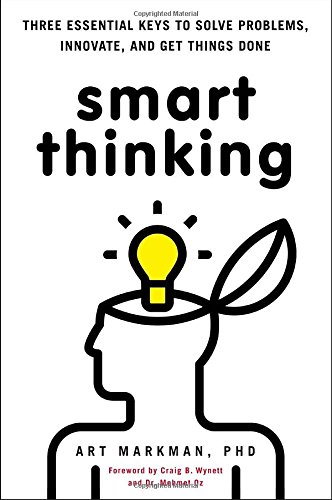
Smart Thinking: Three Essential Keys to Solve Problems, Innovate, and Get Things Done by Arthur B Markman

Smart Thinking: Three Essential Keys to Solve Problems, Innovate, and Get Things Done

Arthur B Markman
259 pages
Perigee/Penguin Group
Dec 2012
Psychology & Philosophy WSBN
3
Readers
1
Reviews
0
Discussions
0
Quotes
Think smart people are just born that way? Think again.<p>Drawing on diverse studies of the mind, from psychology to linguistics, philosophy, and learning science, Art Markman, Ph.D., demonstrates the difference between &quot;smart thinking&quot; and raw intelligence, showing readers how memory works, how to learn effectively, and how to use knowledge to get things done. He then introduces his own three-part formula for readers to employ &quot;smart thinking&quot; in their daily lives.</p><p><i>Smart Thinking</i> gives readers:</p> The means to replace self-limiting habits with new behaviors that foster smart thinking An understanding of the mind itself as well as memory The ability to define and solve problems by finding and applying relevant knowledge Ways to present and process information effectively
Join the conversation

No discussions yet. Join BookLovers to start a discussion about this book!

"There is surely nothing quite so useless as doing with great efficiency what should not be done at

I cite the Drucker observation because it correctly suggests that misdirected efficiency is worse than no effort at all. Why? The problem to be solved is certain to become even worse, if neglected. As I began to read Art Markman's book, I was reminded of a passage from Judgment, a book co-authored by Noel Tichy and Warren Bennis. In the first chapter, they assert that what really matters "is not how many calls a leader gets right, or even what percentage of calls a leader gets right. Rather it is important how many of the important ones he or she gets right." They go on to suggest that effective leaders "not only make better calls, but they are able to discern the really important ones and get a higher percentage of them right. They are better at a whole process that runs from seeing the need for a call, to framing issues, to figuring out what is critical, to mobilizing and energizing the troops." Whatever its size and nature may be, every organization needs what Markman characterizes as "Smart Thinking" at all levels and in all areas of the given enterprise. That is, develop a culture within which everyone involved is prepared to solve new (i.e. unfamiliar) problems using the knowledge they possess including knowledge of where and how to obtain the additional information they may need. Decades ago, Eppie Lederer ("Ann Landers") observed, "If you think education is expensive, try ignorance." I agree, presuming to add that not knowing what you think you know but, in fact, don't is perhaps the most damaging form of ignorance. According to Markman, "Smart Thinking is like chess. Even though it may seem like Smart Thinking must be some kind of talent, it is really a skill" and almost anyone can master it. o James Dyson: How did he come up with the idea for his vacuum? (Pages 8-13) o The Formula for Smart Habits (33-41) o Changing [Bad] Habits (44-54) o Seeing Less Thank You Expect to See (60-71) o Help Others Use the Role of 3 (81-98) Note: This refers to "three simp...

No quotes shared yet. Join BookLovers to share your favorite quotes!

Earn Points
Your voice matters. Every comment, review, and quote earns you reward points redeemable for Bitcoin.
Comment +5 pts Review +20 pts Quote +7 pts Upvote +1 pt
BookMatch Quiz
Find books similar to this one
About this book
Pages 259
Publisher Perigee/Penguin Grou...
Published 2012
Readers 3