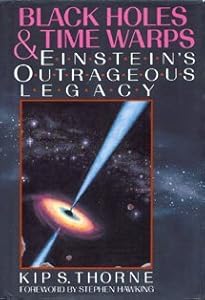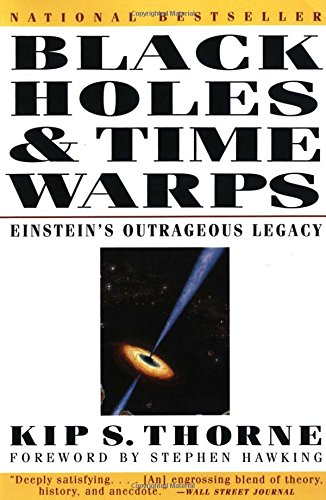
Black Holes and Time Warps: Einstein's Outrageous Legacy by Kip S. Thorne
Black Holes and Time Warps: Einstein's Outrageous Legacy

Kip S. Thorne
624 pages
W. W. Norton & Company
Jan 1971
Science WSBN
4
Readers
1
Reviews
0
Discussions
0
Quotes
Join the conversation

No discussions yet. Join BookLovers to start a discussion about this book!

Readable astrophysics history on black holes, white dwarfs, neutron stars, quasars and worm holes

This book is a tour de force of astrophysics history since Einstein introduced General Relativity. It covers the history and conceptual development of astro physical bodies developed from implosion of stars of any size and the gravitational effects resulted due to General Relativity. It should be a reference book for any students of General Relatvity and astrophysics. It covers black holes, white dwarfs, pulsars, neutron stars, quasars, super novas and binary system involving them, and worm holes. Thorne began with the introduction of General Relativity from Einstein and the introduction of black holes as Schwarzchild's singularities which Einstein rejected due to his reluctance of accepting gravitational singularity. The book continues to show how Chandrasekhar develops the Chandrasekhar Limit of white dwarf as a collapsing star under 1.4 solar mass. Next the book shows how implosion is a normal process of a dying star burning off its fuel; and a neutron star is resulted from an imploding star under 2 solar mass with 10 % of its mass released as energy as developed by Zwicky. Then Thorne discusses his own Hoop Conjecture about how black hole is formed by a hoop over a rotating imploding star at critical circumference. Also discussed in detail is the "black hole with no hair" phenomenon of Price Theory according to which a black hole loses its magnetic field into dissipating gravitational energy during implosion. The search for black hole in the sky began with looking for a possible binary star system one of which is a black hole or neutron star using both optical and x ray telescopes. X ray astronomy is developed as a result of searching for black holes. In such a binary star system, the star would exhibit orbital perturbation due to gravity from the black hole as well as alternating blue and red shift from rotation. Black holes would be emitting x ray in such a binary system. Another area of astronomy that is developed due to black holes research is radio astro...

No quotes shared yet. Join BookLovers to share your favorite quotes!

Earn Points
Your voice matters. Every comment, review, and quote earns you reward points redeemable for Bitcoin.
Comment +5 pts Review +20 pts Quote +7 pts Upvote +1 pt
BookMatch Quiz
Find books similar to this one
About this book
Pages 624
Publisher W. W. Norton & Compa...
Published 1971
Readers 4