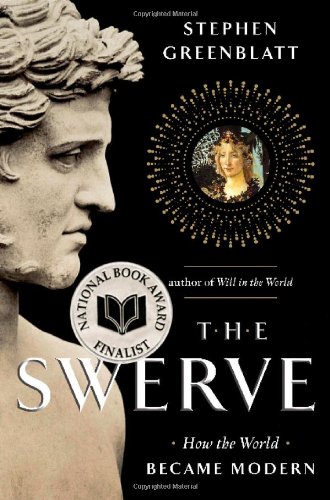
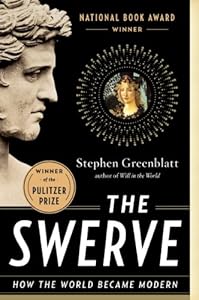
Winner of the 2012 Pulitzer Prize for Non-Fiction Winner of the 2011 National Book Award for Non-Fiction One of the world's most celebrated scholars, Stephen Greenblatt has crafted both an innovative work of history and a thrilling story of discovery, in which one manuscript, plucked from a thousand years of neglect, changed the course of human thought and made possible the world as we know it. Nearly six hundred years ago, a short, genial, cannily alert man in his late thirties took a very old manuscript off a library shelf, saw with excitement what he had discovered, and ordered that it be copied. That book was the last surviving manuscript of an ancient Roman philosophical epic, On the Nature of Things, by Lucretius―a beautiful poem of the most dangerous ideas: that the universe functioned without the aid of gods, that religious fear was damaging to human life, and that matter was made up of very small particles in eternal motion, colliding and swerving in new directions.
So many great topics. Whenever someone asks what impact religion (Christianity) had on the downfall of the Roman Empire and the dark superstitious millennium that followed and how a single text (among many others) of ancient rational thought re-emerged and powerfully influenced modern thinking: this book should be recommended.
Lennart Lopin
2 years ago
Currently reading “Map of Knowlege” which was definitely inspired by this one. Also a great read.
Incredible!
What an incredible and amazing book. A beautiful ode to the men and women who rescued ancient Roman and Greek texts, humanists of the Renaissance and in particular Poggio as exemplified in the story of de rerum natura. This enlightening book traces the story of Western Awakening from the collapsing light of Antiquity through darkness of the Middle Ages and the process of a modern re-awakening. It touches on everyone and everything important with copious notes and references. A delightful read - almost a historical thriller. You won’t be disappointed and in fact feel elevated and thoroughly re-acquainted with one of the most intriguing histories of human ingenuity and its path through the millennia. Well done!
Brilliant, truly pleasurable reading experience with nontrivial caveats
The Swerve is an absolute joy to read. It is written so vividly and with such verve, passion, and breadth of ambition. It is definitely not what I was expecting, though. I thought there would be more, much more, addressing the influence of Lucretius or antiquity in general on world-making and -breaking revolutions in the arts and *especially* the sciences over the centuries, up to the present day. This is, frankly, almost entirely absent. Schrödinger, Heisenberg, and other titans of modern science who revivified traditions in ancient thought in the course of introducing their breakthroughs are absent. The closest this book comes to satisfying any curiosity about Lucretius' influence on the making of the modern world is... honestly it's pretty scant. You'll read the general outlines of the end of Giordano Bruno for the twelfth time. A sprinkle of Galileo too. Greenblatt, rather, seems much more interested in injecting his love of English poetics than exploring any of this - so you'll be reading more excerpted Dryden and Shakespeare than exploring real, material connections between Lucretius and the making of the modern world in any real and significant way. Even Democritus comes up but once or twice. Some puzzling stuff. For the majority of the book, you'll be taking in a gripping narrative of papal intrigue, bibliomania, eccentric monks, and early Christian humanism. This, at least, was to me anyway absolutely new. But yeah, I wish there were more points of contact between the contemporary humanities, particularly intellectual historians and philosophers, and the exact sciences. Cassirer was a one-off, sadly. Even though I was not expecting what was inside, I still rank Swerve among the best books I've read in a while. It was just so rich and fulfilling, even when I feel there are some real shortcomings in its planning. This is a strange review, insofar as I'm coming right out and saying I'm kind of unconvinced by Greenblatt's argument (or the promise of his book...
Liberated from superstition, Epicurus taught, you would be free to pursue pleasure.
Page 76
Compared to the unleashed forces of warfare and of faith, Mount Vesuvius was kinder to the legacy of antiquity.
Page 94
Earn Points
Your voice matters. Every comment, review, and quote earns you reward points redeemable for Bitcoin.






So many great topics. Whenever someone asks what impact religion (Christianity) had on the downfall of the Roman Empire and the dark superstitious millennium that followed and how a single text (among many others) of ancient rational thought re-emerged and powerfully influenced modern thinking: this book should be recommended.