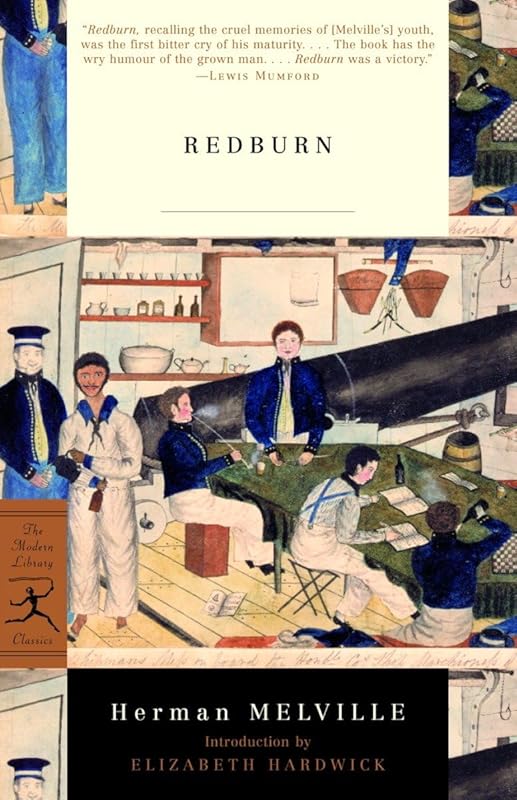
Drawn from Melville's own adolescent experience aboard a merchant ship, Redburn charts the coming-of-age of Wellingborough Redburn, a young innocent who embarks on a crossing to Liverpool together with a roguish crew. Once in Liverpool, Redburn encounters the squalid conditions of the city and meets Harry Bolton, a bereft and damaged soul, who takes him on a tour of London that includes a scene of rococo decadence unlike anything else in Melville's fiction. In her Introduction, Elizabeth Hardwick writes, "Redburn is rich in masterful portraits - a gallery of wild colors, pretensions and falsehoods, fleeting associations of unexpected tenderness. . . . Redburn is not a document; it is a work of art by the unexpected genius of a sailor, Herman Melville."
This Modern Library Paperback Classic is set from the text of the first American edition of 1849. Read more Continue reading Read less REVIEW
"Redburn, recalling the cruel memories of [Melville's] youth, was the first bitter cry of his maturity. . . . The book has the wry humour of the grown man. . . . Redburn was a victory." - Lewis Mumford FROM THE INSIDE FLAP
elvilles own adolescent experience aboard a merchant ship, Redburn charts the coming-of-age of Wellingborough Redburn, a young innocent who embarks on a crossing to Liverpool together with a roguish crew. Once in Liverpool, Redburn encounters the squalid conditions of the city and meets Harry Bolton, a bereft and damaged soul, who takes him on a tour of London that includes a scene of rococo decadence unlike anything else in Melvilles fiction. In her Introduction, Elizabeth Hardwick writes, Redburn is rich in masterful portraitsa gallery of wild colors, pretensions and falsehoods, fleeting associations of unexpected tenderness. . . . Redburn is not a document; it is a work of art by the unexpected genius of a sailor, Herman Melville.
This Modern Library Paperback Classic is set from the text of the first American edition of 1849. FROM THE BACK COVER
Drawn from Melville's own adolescent experience aboard a merchant ship, "Redburn charts the coming-of-age of Wellingborough Redburn, a young innocent who embarks on a crossing to Liverpool together with a roguish crew. Once in Liverpool, Redburn encounters the squalid conditions of the city and meets Harry Bolton, a bereft and damaged soul, who takes him on a tour of London that includes a scene of rococo decadence unlike anything else in Melville's fiction. In her Introduction, Elizabeth Hardwick writes, ""Redburn is rich in masterful portraits--a gallery of wild colors, pretensions and falsehoods, fleeting associations of unexpected tenderness. . . . "Redburn is not a document; it is a work of art by the unexpected genius of a sailor, Herman Melville."
This Modern Library Paperback Classic is set from the text of the first American edition of 1849. ABOUT THE AUTHOR
Elizabeth Hardwick is the author of many books and essays, including American Fictions (available from Modern Library Paperbacks) and Herman Melville. She lives in New York City. EXCERPT. REPRINTED BY PERMISSION. ALL RIGHTS RESERVED.
CHAPTER I
How Wellingborough Redburn's Taste for the Sea Was Born and Bred in Him
"Wellingborough, as you are going to sea, suppose you take this shooting-jacket of mine along; it's just the thing - take it, it will save the expense of another. You see, it's quite warm; fine long skirts, stout horn buttons, and plenty of pockets."
Out of the goodness and simplicity of his heart, thus spoke my elder brother to me, upon the eve of my departure for the seaport.
"And, Wellingborough," he added, "since we are both short of money, and you want an outfit, and I have none to give, you may as well take my fowling-piece along, and sell it in New York for what you can get. - Nay, take it; it's of no use to me now; I can't find it in powder any more."
I was then but a boy. Some time previous my mother had removed from New York to a pleasant village1 on the Hudson River, where we lived in a small house, in a quiet way. Sad disappointments in several plans which I had sketched for my future life; the necessity of doing something for myself, united to a naturally roving disposition, had now conspired within me, to send me to sea as a sailor.2
For months previous I had been poring over old New York papers, delightedly perusing the long columns of ship adver- tisements, all of which possessed a strange, romantic charm to me. Over and over again I devoured such announcements as the following:
FOR BREMEN
The coppered and copper-fastened brig Leda, having nearly completed her cargo, will sail for the above port on Tuesday the twentieth of May.
For freight or passage apply on board at Coenties Slip.3
To my young inland imagination every word in an advertisement like this, suggested volumes of thought.
A brig! The very word summoned up the idea of a black, sea-worn craft, with high, cozy bulwarks, and rakish masts and yards.
Coppered and copper-fastened! That fairly smelt of the salt water! How different such vessels must be from the wooden, one-masted, green-and-white-painted sloops, that glided up and down the river before our house on the bank.4
Nearly completed her cargo! How momentous the announcement; suggesting ideas, too, of musty bales, and cases of silks and satins, and filling me with contempt for the vile deck-loads of hay and lumber, with which my river experience was familiar.
Will sail on Tuesday the 20th of May - and the newspaper bore date the fifth of the month! Fifteen whole days beforehand; think of that; what an important voyage it must be, that the time of sailing was fixed upon so long beforehand; the river sloops were not used to make such prospective announcements.
For freight or passage apply on board! Think of going on board a coppered and copper-fastened brig, and taking passage for Bremen! And who could be going to Bremen? No one but fore