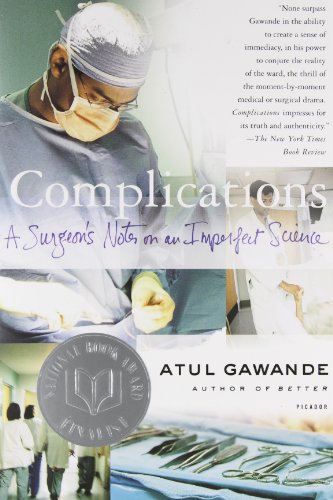
Complications: A Surgeon's Notes on an Imperfect Science by Atul Gawande

Complications: A Surgeon's Notes on an Imperfect Science

Atul Gawande
269 pages
Picador
Apr 2003
Textbooks WSBN
3
Readers
1
Reviews
0
Discussions
0
Quotes
Amazon.com Review Gently dismantling the myth of medical infallibility, Dr. Atul Gawande's

No discussions yet. Join BookLovers to start a discussion about this book!

Compelling non-fiction?? Yes

How many non-fiction books have you read which you would describe as “hard to put down?” Describing a work of fiction as such is high praise. Non-fiction? It is a unique thing to write and indeed high praise. “Complications” is hard to stop reading. I appreciate Gawande’s attempts at candor, exposé (which it is not not but approaches), and balance. I appreciate his efforts to provide generalized / generalizable insights, illustrated by poignant anecdotes; and, I appreciate reading his point of view about those aspects of care which defy generalization. All writing has bias. It is inherent even if accepted conventions are followed flawlessly. It is therefore well to acknowledge that statements made in this book are also subject to error; and it is well to illustrate at least one specific instance. The author has written (page 249 of the Kindle edition), “His [Jack Wennberg’s] research has shown, for example, that the likelihood of a doctor sending you for a gallbladder-removal operation varies 270 percent depending on what city you live in; for a hip replacement, 450 percent; for care in an intensive care unit during the last six months of your life, 880 percent. A patient in Santa Barbara, California, is five times more likely to be recommended back surgery for a back pain than one in Bronx, New York. This is, in the main, uncertainty at work, with the varying experience, habits, and intuitions of individual doctors leading to massively different care for people.” The last sentence is inaccurate. Publications available at DartmouthAtlas.org, demonstrate that availability is a statistically significant factor in explaining much of the variation in surgical utilization from region to region. In other words, where surgery centers exist, surgeries which that center specializes in will indeed be done disproportionate to optimal care or even need. Stated more harshly, surgeons get paid to do surgeries. One cannot rule out financial incentive as a reason for the observe...

No quotes shared yet. Join BookLovers to share your favorite quotes!